
Computer Science, Off Course! Episode 9 - Objectivity
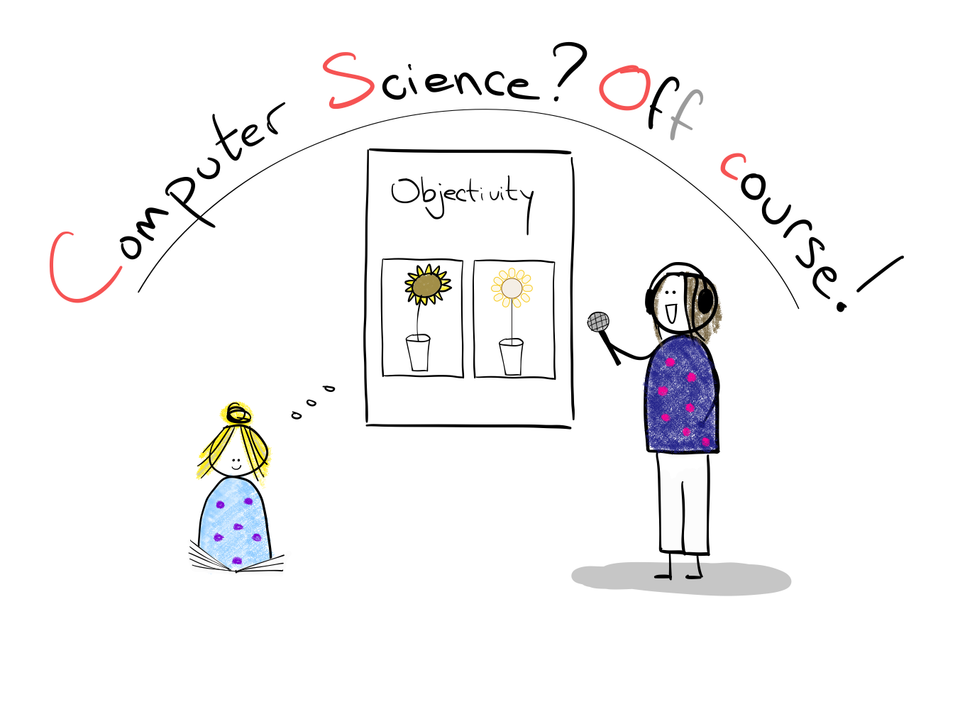
Today's episode is on the book Objectivity by historians of science Laura Daston and Peter Galison.
Let's start with a question!
Imagine your favorite flower (or animal, or something else, it really does not matter which you pick). Now imagine you have to show an image of it to someone who has never seen it, one image only.
What would you pick:
- A photo, a perfect example of one specimen?
- Or an idealized drawing of a perfect version of the flower?
It is so cool, in these two options, you immediately see that both have their pros and cons! This book is about exactly this question, which of those options is better, or rather, which is more 'objective'?
Through a history of scientific atlases (and thus also beautifully illustrated) this book studies the history of the concept of objectivity and it is so incredibly interesting. This book might be absolutely most "out there" for this first season of Computer Science Off Course, but it is so insightful.
Firstly, the whole notion that objectivity is a relatively new concept! While today, you would think that being objective as a scientist is the absolute most important property there is, and that that must have always been the case, that is not at all true.
The book roughly sketches three periods in the history of objectivity, which each roughly correspond to an answer to the question above. The book explains how earlier generations of scientists (they name Linneaus as one example) were not at all interested in being objective, they would absolutely have voted 2, and created an idealized image (Goethe called such an idealized plant an "Urpflanze"). Objectivity then was not a goal, as objective means removing the knower from the process, whereas in those days, scientists wanted to center the knower. Only someone really knowledgable could create a useful Ur-image.
Only later did objectivity become a virtue:.
[O]bjectivity is the suppression of some aspect of the self, the countering of subjectivity. Objectivity and subjectivity define each other, like left and right or up and down. One cannot be understood, even conceived, without the other. If objectivity was summoned into existence to negate subjectivity, then the emergence of objectivity must tally with the emergence of a certain kind of willful self, one perceived as endangering scientific knowledge. The history of objectivity becomes, ipso facto, part of the history of the self.
One reason the book explains for the advent of objectivity, which is so fascinating, is that in earlier days, the goal of science was to find the truth, is simply just needed to be uncovered. However, as new discoveries followed each other, new truths were being found all the time. Clearly, finding truth could no longer be a goal, if it was so volatile!
As they write:
The headlong pace of scientific progress experienced within a single lifetime seemed to threaten the permanence of scientific truth. Scientists grasped at the new conceptual tools of objectivity and subjectivity in an attempt to reconcile progress and permanence.
There are great quotes in the book how, contrary to what you might think as a simply solution, this was not because photography was invented and objectivity suddenly became technologically possible. The desire for objectivity <ontsond> separate from technology.
This was not because the photograph was more obviously faithful to nature than handmade images — many paintings bore a closer resemblance to their subject matter than early photographs, if only because they used color — but because the camera apparently eliminated human agency.
It is a lovely book to read, I found it hard also (it took me three summers to finish!) because it is such a new way of looking at the world and at science.
Objectivity was a different, and distinctly epistemological, goal — in contrast to the metaphysical aim of truth.
It of course made me think of Computer Science, even though as I said the book is not at all about our field. Is our goal to find the truth? If so, which truths? When do we aim to be 'objective', and how do we know we are?
The drops story
The book opens with a beautiful anekdote about the role of technology in science but also about the human mind, about a scientist <> trying to capture the shape of water drops. Before photography he did this by flashing a light on the splashes and then quickly drawing the shape. When he got access to photos however, he noticed how much more jagged and imperfect than he thought. His mind had, even though he was trying to avoid it, projected shapes onto the drops.
How science and measurability captures all fields
One other things that the book talks about, although it is not a main point, is about measurability. Measurability is very much connected to objectivity, as numerical values were (and are) seen as most neutral or objective, even though of course, the way the numbers are collected, analyzed and presented van never be neutral.
Daston & Galison write for measurability psychology became "natural sciencified":
It was the task of psychology “to define the empirical characteristics that objects must have in order to be enumerable.” Through a combination of sensory physiology and psychology, the laws of thought would be shown to be natural laws, discoverable by the same objective methods that had led to Helmholtz’s own discovery that the speed of nerve impulses was finite. As he wrote triumphantly to his father, thought itself could be made the stuff of experimental science.
Reaction time for example was an important measure:
Time was the dimension that submitted mental processes to measurement; time was also the dimension that connected abstract number to concrete experience, contended Wundt.
Math, of course, is the most objective of all:
“In arithmetic,” Frege concluded [...] “we are not concerned with objects which we come to know as something alien from without through the medium of the senses, but with objects given directly to our reason and, as its nearest kin, utterly transparent to it.… And yet, or rather for that very reason, these objects are not subjective fantasies. There is nothing more objective than the laws of arithmetic.”
This all of course made me think a whole lot about last week's episode on Turkle and her take on the colonialism of AI research <>.
Epistemology (and the lack thereof in CS)
In essence, this is a book on epistemology, and for me it was the first book that I read really on this topic, so a lot of what I take away might be absolutely logical for 'normal people' that learned about this stuff outside of a CS program.
I found this quote to be absolutely insightful:
All epistemology begins in fear — fear that the world is too labyrinthine to be threaded by reason; fear that the senses are too feeble and the intellect too frail; fear that memory fades, even between adjacent steps of a mathematical demonstration; fear that authority and convention blind; fear that God may keep secrets or demons deceive.
We tend do view wear, as we say in Dutch, as a giver of bad advice, but here we see that fear might be fact be good. It made me think what Computer Science research fears. I see how the natural sciences might fear not collecting enough data or holding on to a hypothesis for too long, or how ethnography or sociology might fear to be too subjective, too influenced by personal experiences.
Does CS fear anything? Does that reflect in research methods?
Emotions in research
One thing that is also fascinating about this book is how it talks about emotions that people experience while doing research, something I think we rarely discuss! This starts with the milk drop story, but in many examples emotions are discussed, and how some are seen as good (self restraints but also passion) and some as bad. They write:
Emotion per se was no disqualification; a fiery temper and a passionate commitment to research were, as in the cases of Michael Faraday and Cajal, regarded as perfectly compatible with scientific objectivity. But passionate preferences for one’s own theories and speculations [...] or even for one’s own sensations and intuitions [...] count as dangerous expressions of subjectivity.
The tattoo!
Quests for truth and quests for objectivity do not produce the same kind of science or the same kind of scientist.
or maybe...
Machines were ignorant of theory and incapable of speculation: so much the better.
Homework
- I found the question what we fear in CS absolutely fascinating to think about.
- And, if you dare, consider whether you are a truth finder or an objectivity chaser, and why?
- This could be done, maybe, be sampling some recent papers and discussing their (implicit) views?
Hanna's homework is, again, lovely! She adds one more dimension to the quest for good science, where she reflects on beauty in science, and finding knowledge that helps to make the world a better place!
Member discussion