
Computer Science, Off Course! Episode 8 - Breaking things at work
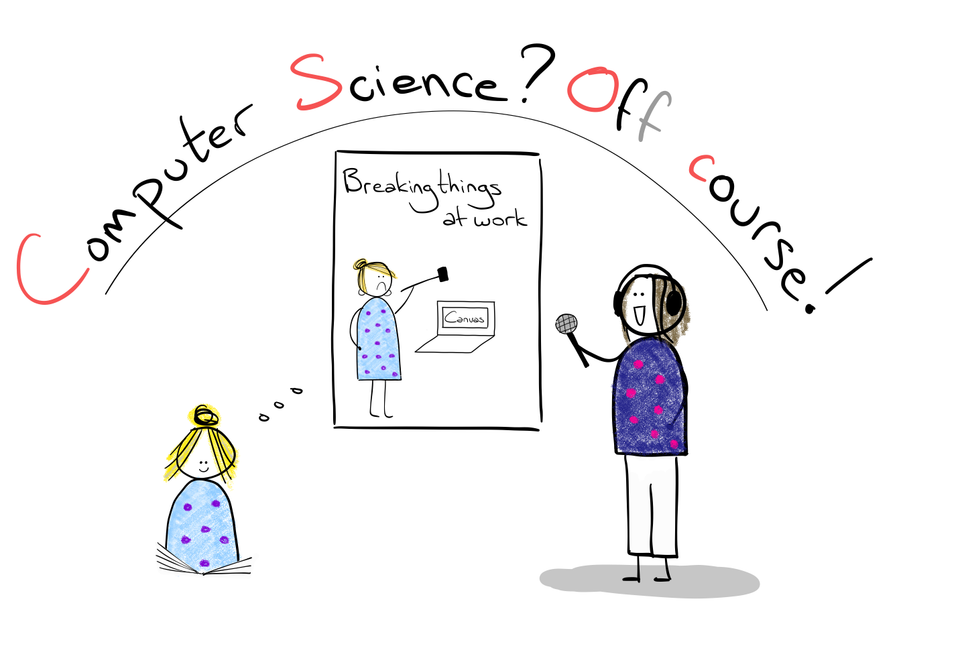
Yes, of course there is a new Off course!
This one on a book that is the least computer sciency we have done so far, I think, the book Breaking things at work by UvA professor Gavin Mueller. There is nothing directly computer-related in the book.
What the book does is present a history of the luddites, a word previously, up until I would say the chatGPT mainly used as a slur for technology-haters, it now seems to be making a comeback as meaning people that are critical of technology for good reasons, see also a few recent blog posts, especially one in my favorite magazine n+1 Large Language Muddle (I wrote about it earlier in 2026).
However, the book is about power, about for example, the power that workers have when they come together against capital. In the luddite days, these were the owners of factories, now they are makers of LLMs.
What were the Luddites?
Mueller explains, much needed, that luddites were not against technology per se, in a quite epic saying "To say they fought machines makes about as much sense as saying a boxer fights against fists." Workers did not always oppose all technology, rather they "often adopted elements of new cotton-spinning technologies to suit their work processes. For example, English weavers complained that bosses refused to implement “racks,” devices that accurately measured productivity, and therefore secured workers’ piece-rate wages."
What Luddites were fighting against were the fact that only capital was reaping the benefits of the technology, while their work got 1) worse paid and also 2) worse to do, limiting their freedom.
What workers bitterly opposed was “industrial concentration” that demolished their way of life by undermining the autonomy they possessed in small-scale home
The interesting thing I learned from Mueller’s book is that workers like weavers in the 18th century had quite some freedom, they could work whenever they wanted, often worked from their homes, and could feed their families with relatively little work. They were also really proud of making good fabrics, durable and beautiful ones, that gave them a sense of pride. In other words, they demanded:
“worthy work,” which “carries with it the hope of pleasure in rest, the hope of the pleasure in our using what it makes, and the hope of pleasure in our daily creative skill.
They fought for the right to enjoy their work enough, a very worthy goal I would say. Their fight, they said
will not be finally conquered till our work becomes a part of the pleasure of our lives—that is, until we find our work rewarding.
They also campaigned for a lot of other forms of reform, a lot of these were actually successful!
Their politics not only took the form of violent activity but was also enunciated through voluminous decentralized letter-writing campaigns, which petitioned— and sometimes threatened—local industrialists and government bureaucrats, pressing for reforms such as higher minimum wages, cessation of child labor, and standards of quality for cloth goods.
As always history is written by the victor, and thus luddites have become failures in the public eye, people that resisted without any success, but that image is not true at all!
This did remind me so much of bit tech from lets say 2010 to 2020, when tech workers had so so much power to go work elsewhere, that they could have transformed into collective benefits, not so much for better pay, but for better work, for them and their colleagues in big tech with less power. And yeah I know unions are definitely different things the in US versus in Europe but still, programmers could have made more demands, certainly they would have benefitted from that now, as would have others.
However, tech workers did not sympathize with below, but rather with above, which is, Mueller explains, what often happens:
the industrious professional middle-class men of today purified from their crime of complicity with the monopolist class
This is why certain forms of technology get adopted and other forms do not.
An alternative form of automation popular among machinists, “record-playback,” was never seriously pursued, although it was also efficient. Unlike numeric control, the record-playback method was analog, storing the precise movement of a machinist, and so still required a skilled hand. Rather than pursue efficiency, management sought to wrest control of production away from the machinists.
In the episode Hanna asked what the relationship is between this book and Marxism. That is a though question, as Marx himself famously said he was not a Marxist, so what does it even mean?
The connection I would say between luddites and Marx is an opposition to centralized control and the accompanying loss of freedom and quality of work and life.
Technology and Taylorism
Braverman's quote I think sounds very familiar to people using software today, I wrote next to this quote "like grading a thesis". As Mueller explains, engineer Frederick Taylor was instrumental in this movement:
Formerly, the workmen earned a fixed amount for turning each tire to size. But once Taylor was through, their job was no longer to machine a tire but was a succession of smaller tasks: Set tire on machine ready to turn. Rough-face front edge. Finish-face front edge. Rough-bore front. And so on, each step minutely described and timed to the tenth of a minute.
I find it interesting that one of the most impactful ideas in management in the 20th century comes from an engineer!!
Mueller explains, in the words also of Braverman (maybe we can do an episode on him in the future too!) how before automation could happen, the work first already had to be made measurable using words of progress:
The modernizing terminology of “science” and “efficiency” masked the prerogatives of discipline and control of workers. In political economist Harry Braverman’s estimation, “Taylor raised control to an entirely new plane when he asserted as an absolute necessity of adequate management the dictation to the worker of the precise manner in which work is to be performed.”
Technology is never neutral
What the book also talks about is how technology is not neutral, rather:
Instead, the more fundamental problem of technology is its role in the reproduction of hierarchies and injustices foisted upon most of us by business owners, bosses, and governments.
This is something I think we never talked about in CS, as mentioned in a previous episode, I have never really thought of abstraction or databases as negative things, but of course, they do force people into preexisting schemes that so often take away power from workers. We do now regularly talk about bias in algorithms (this is good!) but we don’t talk about this way often enough (but we will talk about it next episode on more depth!)
Tech can’t just be put to a different use
Mueller also has some critical words on the idea of some Marxists that technology was neutral and could just as easily be placed, as the Luddites wanted, in the hands of workers:
Based on a particular interpretation of Marx’s theory, they believed that capitalism, in its pursuit of profit, raised productivity through competitive technological innovation and the discovery of efficient working methods. These discoveries had no politics of their own; technology was neutral and could be appropriated with a change in ownership from private capital to state control, and thereby used to emancipate workers from drudgery.
Or, more concise:
the Communists were equally convinced that the same technology that served capitalism could also serve socialism.
This is also what is currently argued by modern authors in the Marxist tradition, such as Yanis Varoufakis.
While of course, as we learn from Mueller’s book very well, the whole notion of Taylorist technologies is to first change the work, break it up into pieces, lessen those and then automate. In this, they forgot, says Mueller,
the social content of this production: the way production intimately shaped the arrangement of human beings, their culture, and their struggles.
This I think is very important in the conversation we are having today about AI. People keep insisting it can be used in a “good” way, a way that empowers, that democratizes, but they forget that the form of LLMs already has a politics in it, one that is shaped by, and further shapes, capitalist systems.
I know I keep saying this, but only the notion that a question that one can formulate has an answer, an answer that can be known, summarized and easily digested already makes question asking alike to consuming, which it certainly is not like in many cases!
Anti-racist and feminist perspectives
One compliment I must give out about this book, is that Mueller also includes perspectives form outside traditional groups, such as Malcolm X and the Black Panthers:
In the 1972 update to the Black Panther Party’s Ten-Point Program, the last point added “people’s community control of modern technology” to the demands for “land, bread, housing, education, clothing, justice, peace.
And
Cynthia Cockburn [...] plainly states. “Industrial, commercial, military technologies are masculine in a very historical and material sense. They cannot readily be used in a feminine, nor even a sexless, mode.”
He also quotes Ruth Schwartz in her explanations that technology has not (and will not) help women do less housework (I talked about her book before in my Dutch newsletter). Mueller quotes:
Because domestic labor is a relation of patriarchal power, technology will not liberate women. Instead, their time will be filled with more domestic work: “We all know the saying too well: you can always find work to do in a house.” They conclude that it is instead feminism, not technology, that will liberate women from housework.
What computers do to us
This is a quote that made me think of Hanna most for this book:
However, with the introduction of machines, and especially computer interfaces, to replace worker skill, jobs became a set of abstract instructions that workers had to cognitively interpret and understand, rather than a set of embodied actions
This could also make a great homework exercise, to think of what the computers make us do (sort of the opposite of the dominant narrative where computers do stuff for us).
And this leads us to, for me, the biggest thought of the book: computers can be bad. Which is a thing you don't really hear if you study computer science, I feel I was radicalized into believing—even though it was not said explicitly—that an automatic system, a computer system, is always better. We never really learned to think of computers as things that do damage.
And Mueller also nicely quotes Nolen Gertz, in Nihilism and Technology:
Modern technologies appear to function not by helping us achieve our ends but instead by determining ends for us, by providing us with ends that we must help technologies achieve. Thus the Roomba owner must organize their home in accordance with the maneuvering needs of the Roomba, just as the smartphone owner must organize their activities in accordance with the power and data consumption needs of the smartphone. Surely we buy such devices to serve our needs but, once bought, we become so fascinated with the devices that we develop new needs, such as the need to keep the device working so that the device can keep us fascinated.
The tattoo quote!
A "matryoshka" quote in which Mueller quotes Benjamin, who quotes Marx:
[Walter] Benjamin is even more explicit on this point: “Marx says that revolutions are the locomotive of world history. But perhaps it is quite otherwise. Perhaps revolutions are an attempt by the passengers on this train— namely, the human race—to activate the emergency brake.
Homework
- What is the set of "abstract instructions" that computer systems force you to you "interpret and understand"?
Hanna's homework is here! It is great homework (as always, though provoking), as Hanna turns out to be a master at breaking things at work, but not a luddite!
Member discussion