Volkskrant: Alle taken?
Een nieuwe column! Je kan m ook lezen op de site van de Volkskrant!
Everything humanity has ever created, every task, every achievement, will very soon be performed better by artificial intelligence’, aldus ex-Googler en schrijver Mo Gawdat.
We horen tegenwoordig bijna niets anders: AGI – artificial general intelligence – is er bijna.
In eerste instantie klinkt het redelijk; wie weleens met ChatGPT chat, moet toegeven – zelfs ik moet dat toegeven – dat het indrukwekkend is wat eruit komt: hoeveel kennis het bevat en hoe die mooi geformuleerd naar buiten komt, vaak met humor en precisie. Maar wie even verder denkt, vraagt zich toch af of het echt over iedere taak gaat.
Bedoelt Silicon Valley hiermee ook het bakken van een ei, het breien van een mutsje of het inzwachtelen van een kindje, precies zo strak dat het veilig voelt maar niet te strak? Alles wat bij een echt mensenleven hoort, valt hier handig buiten de scope. Denk eens aan de ‘taak’ van een kind leren fietsen. Denken we echt dat AI dat beter kan dan mensen?
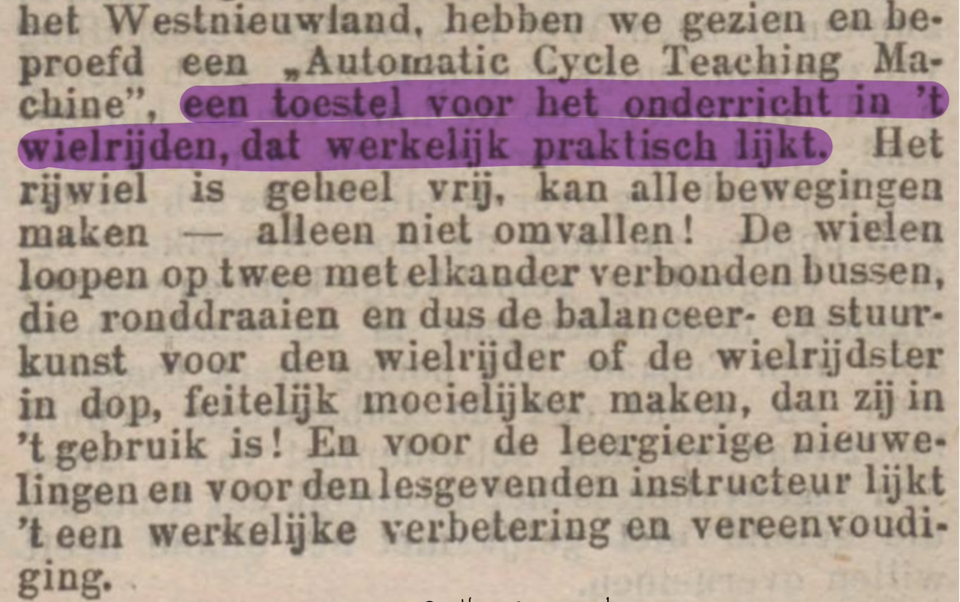
Dat kun je alleen denken als je het mechanische aspect van leren fietsen losweekt van iedere relationele betekenis. Iets wat trouwens niet nieuw is, maar in 1899 al werd geprobeerd met de ‘Automatic Cycle Teaching Machine’, een toestel voor het onderricht in het wielrijden dat werkelijk praktisch lijkt.
Tsja, dat sloeg niet aan, want je kind leren fietsen is net zo goed een taak voor jou als voor je kind. Het is een oefening, letterlijk, in loslaten. Voor je geestesoog zie je ze al wegfietsen, naar het zwembad, de middelbare school, het café, hun eigen huis. Maar je moet je concentreren op de versie van je kind die hier nu naast je fietst, wiebelend en angstig. Je moet roepen ‘je kan het’, terwijl je dat zelf helemaal niet gelooft. Hoe kan jouw baby met zijn mollige pootjes nu opeens al op een fiets zitten! Maar het wordt waar doordat je het roept; een zeldzaam voorbeeld van manifesteren dat werkt.
‘Interpretative labour’ noemt etnograaf David Graeber dat, wanneer je moet bedenken wat een ander nodig heeft. Heeft je kind aanmoediging nodig, of juist dat jij inziet dat het nog te moeilijk is?
In het professionele leven zijn het meestal mensen in zorgende beroepen, laag in de pikorde, die dat soort werk moeten doen. Iedere goed geoliede ‘machine’ van de menselijke soort – of dat nu een restaurantkeuken is, een ziekenhuis of een kinderopvang – leunt op onzichtbaar werk dat interpreteert, fikst en oplost en dat niet zomaar te vangen is in regels en systemen.
En wat te denken van het werk der werken: een baby ter wereld brengen – niet voor niets in het Engels ‘labour’ geheten. Een moeilijkere taak kun je je niet voorstellen, tenzij je alleen cognitieve taken meetelt. Want het maken van een mensje doe je niet bewust met je brein; je hoeft je helemaal niet te concentreren om een wijsvingertje of een rechterlong aan te maken, en toch maak je intelligentie. Wat is intelligenter dan dat?
Maar al dat werk sluit big tech uit: zorgen, aandacht en lichamelijkheid. Alleen het denken van de mens telt als iets wat gesimuleerd moet worden. Alle andere dingen die mensen doen en machines niet – poepen, zingen, fietsen, seks, boos worden, rouwen – leggen onmiddellijk de smalle interpretatie van ‘alle taken’ bloot.
Zoals Graeber zegt, had scientific management nooit kunnen lukken als het canonieke voorbeeld van werk dat van een kok, tuinman of masseur was geweest. Net zo kan het verhaal van AGI niet slagen als we bij denken denken aan denken dat inlevingsvermogen vergt.
English
Everything humanity has ever created, every task, every achievement, will very soon be performed better by artificial intelligence, according to former Googler and author Mo Gawdat.
It all we hear in 2026: AGI – artificial general intelligence – is almost here.
At first glance, it sounds reasonable; anyone who’s ever chatted with ChatGPT has to admit – even I have to admit – that what comes out is impressive: how much knowledge it contains and how beautifully it’s expressed, often with humor and precision. But if you think about it a bit more, you start to wonder if it really applies to every task.
Does Silicon Valley also mean frying an egg, knitting a hat, or swaddling a baby, just tight enough that it feels safe but not too tight? Everything that belongs to a real human life conveniently falls outside the scope here. Think about the "task" of teaching a child to ride a bike. Do we really think AI can do that better than humans?
You can only think that if you separate the mechanical aspect of learning to ride a bike from any relational meaning. Something that, by the way, isn’t new, but was already attempted in 1899 with the "Automatic Cycle Teaching Machine: a device for teaching cycling that actually truly practical".
Well, that machine did not really catch on, because teaching your child to ride a bike is just as much a task for you as it is for your child. It is an exercise, literally, in letting go. In your mind’s eye, you can already see them cycling away – to the pool, high school, the café, their own home. But you have to focus on the version of your child who is cycling right here beside you, wobbly and anxious. You have to yell "you can do it", even though you don’t believe it yourself. How can your baby with those chubby little legs suddenly be sitting on a bike! But it becomes true because you say it; a rare example of manifesting that actually works.
Ethnographer David Graeber calls this "interpretative labor" – when you have to figure out what someone else needs. Does your child need encouragement, or do you need to realize that it's too hard for now?
In professional life, it's usually people in caregiving professions, low on the pecking order, who have to do that kind of work. Every well-oiled "machine" of the human kind—whether it'’s a restaurant kitchen, a hospital, or a daycare center – relies on invisible work that interprets, fixes, and solves problems, and that can’t simply be captured in rules and systems.
And what about the work of all works: bringing a baby into the world, the "labor" of labors. You can’t imagine a more difficult task, unless you only count cognitive tasks. Because you don’t consciously create a human being with your brain; you don't have to concentrate at all to create a little index finger or a right lung, and yet you're creating intelligence. What could be more intelligent than that?
But all that work excludes big tech: care, attention, and physicality. Only human thought counts as something that needs to be simulated. All the other things people do that machines don't—pooping, singing, cycling, having sex, getting angry, mourning—immediately expose the narrow interpretation of "all tasks".
As Graeber says, scientific management could never have succeeded if the canonical example of work had been that of a cook, gardener, or masseur. Similarly, the story of AGI cannot succeed if when thinking about thinking, we think of thinking that requires empathy.
Member discussion