
AI in week 16
Deze week een stuk in NRC van mijn hand als antwoord op de vraag hoe we over 5 jaar naar deze AI hype kijken. Hopelijk zijn we dan bijgekomen van de klap en vinden we menselijk weer mooi, en dan kunnen we nadenken over de vraag "Wat wás die AI hype in godsnaam?"
"Mokken, shirts en stickers met de slogan „no LLMs were harmed in the making of this content" waren niet voor niets de hype van 2028: een dikke vette knipoog naar de doomers die geloofden dat AI een bewustzijn heeft en echt kan lijden.
Met het afnemen van de populariteit van Amerikaanse tech-platformen en het toenemende fascisme in Amerika, bleek er steeds meer draagvlak voor het aan banden leggen van sociale media. De verslavende kenmerken, zoals endless scroll, aangeraden en gesponsorde content, werden verboden, en zonder die functies bleken de apps lang zo leuk niet. Met meer keuze over digitale consumptie kozen mensen en masse voor menselijkheid en voor relaties. "
Wie mijn nieuwsbrief al langer leest ziet dat ik heb geprobeerd alles waar ik om geef in het stuk te proppen: de macht van big tech, publicatiedruk in de wetenschap en menselijkheid!
En ja, mensen hebben het echt al over het idee dat "mens gemaakt" een premiumlabel aan het worden is. Ook onderzoeker en kunstenaar Eryk Salvaggio beantwoordde de vraag "Wat was ChatGPT?", maar dan over hoe chatbots een verlengstuk zijn van de coronacrisis:
What captured our imaginations during that time, in response to the failure of language to describe our experiences, was ChatGPT. With no inner life, ChatGPT could relentlessly pave over the failure of words to describe our own anxieties. Its bursts of conversational text matched the limits of anxious attention spans. It shifted when we got bored, and we owed it no apologies. It agreed with any position we took. In our lapses of executive function, it could create a plausible bare minimum checklist for us to get through the day.
Ikjes!
En dan natuurlijk de prijswinnaars van het boek van Jan-Jaap. De winnaars hebben inmiddels van mij een mailtje gehad. Niet gewonnen? Je kan het boek natuurlijk ook gewoon zelf aanschaffen! En treur niet, er komt over een week of twee weer een fijne winactie aan!
Hier een paar winnaars die ik mocht delen:
Ik geef les aan Sportkundestudenten, en helaas gebruiken velen ChatGPT 😉. Na de les had ik een leuk één-op-één moment met een student. Ik vertelde dat ik deze zomer een feest geef met als thema 'taboe', en we brainstormden over outfits. Vlak voor het einde van de les zei hij ineens: "Ik weet het al… ik zou als ChatGPT verkleed gaan!"
Dit vond ik een mooi moment, want kritisch geluid op Chatgpt geven is inderdaad taboe 😉
(Charlote Galema, Docent Sportkunde Hogeschool Windesheim)
en deze!
Ik werk in groep 8 en omdat AI niet meer weg te slaan is uit de computers van deze ontluikende pubers heb ik hand in eigen boezem gestoken en ze gezegd dat zij een pitch mochten schrijven met AI. (Geen uitleg over prompt, niets.) Gewoon de eisen: een pitch, 2 minuten, voor 12 jarigen adhv eigen gevonden informatie. Dat kon AI natuurlijk wel! En zo gezegd, zo gedaan. Leerlingen enthousiast, snel aan het werk, en toen een prompt gemaakt onder mijn toeziend oog.
Toen ik alles voor ze ging printen en ze de verschillende pitches in tweetallen gingen oefenen vielen er kwartjes.
'Juf? Ze zijn allemaal hetzelfde?' 'Huh, hoe kan dit?' 'Huh? '
Tja, dat is AI jongens, IKEA effect.
Er volgde uiteraard een groepsgesprek met daarin toch wel de verbazing over deze massaproductie van AI.
Ik heb zo gelachen. Beste les van mijn leven. 🙂 (zonder naam gedeeld)
en deze!
Soms maak je het verschil…En weet je dat gewoon niet.
Bij de diploma uitreiking kwam een meisje binnen met een enorme bos bloemen. Wat leuk dacht ik, heeft ze die van haar ouders gekregen of is die voor haar mentor? Toen kreeg ik de enorme bos bloemen omdat ik als haar mentor in klas drie echt het verschil had gemaakt. Ik reageerde: "dat had toch niet gehoeven, het was vanzelfsprekend dat ik dat deed." Nou… dat vonden de ouders niet. Tot op vandaag weet ik niet wat ik voor speciaals gedaan heb. Dat hoeft ook niet, het is al genoeg dat je de leerlingen net dat zetje mag geven.
(Susan Firing, Docent Marianum Groenlo)
Dank voor alle leuke inzendingen, het was genieten!
The kids are allright!
Waaaaaat een fijn stuk van LAKS, waarvoor ze ook mij bevraagd hebben. Vol met kritische noten over bias, milieu-impact en kansengelijkheid. Met zulke kinderen hoeven we ons over de toekomst eigenlijk geen zorgen te maken!
Het blijft daarom belangrijk om te beseffen dat een leraar meer weet dan een algoritme ooit kan weten: de thuissituatie, motivatie, spanningsboog of onzekerheid van een leerling.
LAKS onderstreept ook het belang van de frictie die door AI weggenomen wordt:
Om te leren moet je doorzetten wanneer iets lastig is en het opnieuw proberen als het niet meteen lukt. Daarvoor bestaat geen kortere weg. Leren kost moeite.
En, potjandriedubbeltjes, wat te denken van dit pleidooi voor het papieren schoolboek...? Van die tieners die het volgens de fanboys "toch allemaal al gebruiken":
Stel je eens voor dat we vanaf nu schoolboeken gaan gebruiken waarvan we weten dat er om de zoveel pagina's een aantal fouten in staan. Soms kleine foutjes, soms grotere fouten. En stel je dan ook eens voor dat elke leerling andere fouten in die schoolboeken heeft staan. Zouden we dat dan willen? Waarschijnlijk niet. Dan kiezen we toch voor de schoolboeken waarvan we weten dat de informatie klopt [...]
Balsem op de ziel voor wie her en der te kakken gezet werd voor precies deze opvatting, nou hoort u het eens van de kinderen [[1]] ! Ok, ik zal nu stoppen; ik had het hele stuk gewoon kunnen afdrukken zo fijn voelt dit, nog een uitsmijtertje dan:
[Z]elfs wanneer we AI 'goed gebruiken', [neemt] niet alle negatieve impact weg, zoals we in dit visiestuk hebben geschetst: kansenongelijkheid, duurzaamheid, en de groeiende afhankelijkheid van Amerikaanse techbedrijven in ons onderwijs. Ook de druk om alles efficiënter te maken kan ten koste gaan van pedagogische kwaliteit. Dat vraagt om blijvende terughoudendheid en kritisch bewustzijn over de vraag of en wanneer we AI überhaupt willen inzetten.
[[1]]: Geestig wel hoe sommige bekende hypers onder de Linkedin-post van LAKS reageerden dat ze zo blij zijn met dit stuk, hebben die het wel gelezen dan verder dan de titel "Naar een bewuste inzet van generatieve AI"?
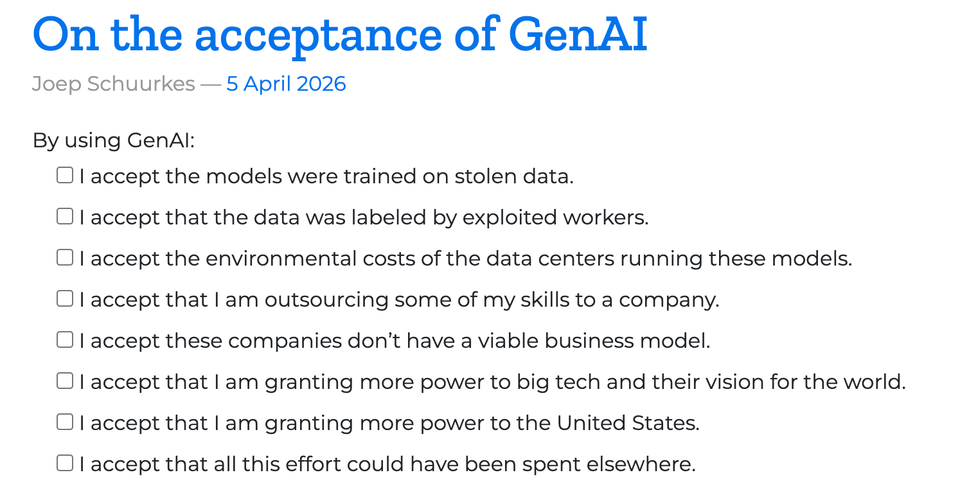
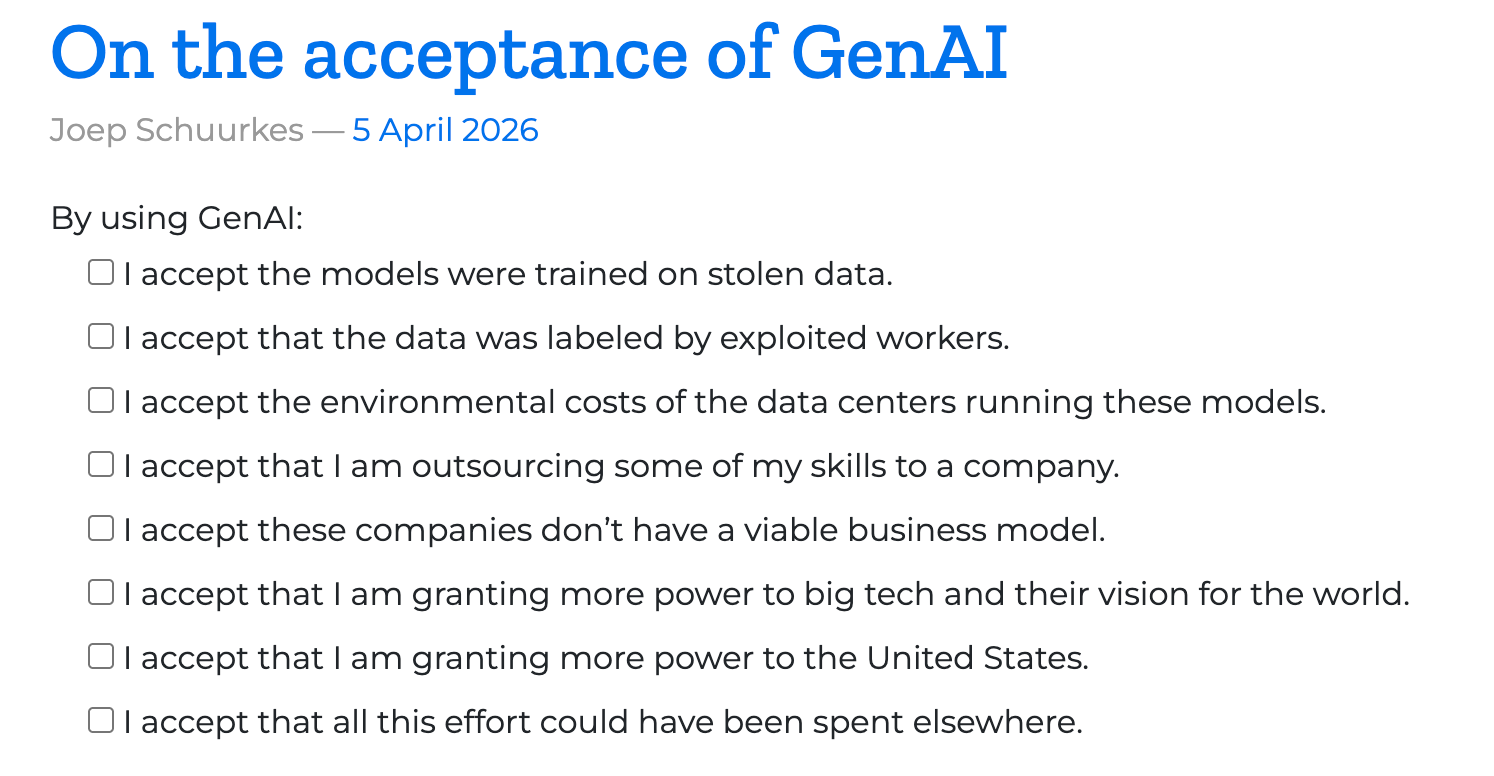
Het deed me denken aan de "gebruikersvoorwaarden" van AI die programmeur Joep Schuurkes vorige week online zette:
Over trans mensen
Ok dan even iets heel anders: trans mensen bestaan! Helemaal geen AI, maar ook weer wel, want zoals alle discourse tegenwoordig heeft de digitale wereld overal mee te maken. Trans mensen, even voor alle duidelijkheid dat zijn mensen die zich een ander geslacht voelen dan ze mee geboren zijn. Soms voelen ze dat zo sterk dat ze ook willen leven als iemand van een ander geslacht. That's it.
Het is zo verleidelijk om te denken dat lelijk doen over trans mensen normaal is, en altijd al zo geweest. Maar vroeger was er veel meer acceptatie, in Goede Tijden uit de jaren '90 bijvoorbeeld! Er komen heel wat stereotypen langs—"wat moet ik meenemen [voor de trans vrouw in kwestie], een bosje bloemen of een kratje bier?" zegt karakter Arthur—maar uiteindelijk wordt ze geaccepteerd als wie ze is. Alhoewel het dan weer erg jammer was dat juist een kinderprogramma—meestal zachter en vooruitstrevender dan tv voor volwassenen—TeleKids Meta tot in lengte der dagen bleef parodiëren, en dat dat beeld bij mensen van mijn leeftijd meer bleef hangen dat het re-la-tief vooruitstrevende grotemensenequivalent.
In Amerika liepen ze op ons voor, daar werd al uiterst redelijk gedaan in een aflevering van de Love Boat uit 1982! Ook daar worden de vooroordelen geuit ("ik weet niets van 'dat soort' mensen"), maar in een groter stuk aflevering komt een ander karakter voor de trans vrouw op en daardoor tot berouw, inzicht en acceptatie. En in Twin Peaks uit 1990 zit een trans karakter, gespeeld door David Duchovny, die een FBI is en wiens backstory er maar weinig toe doet. Iemand noemt haar een keer bij haar vroegere naam, zegt sorry, case closed. Kijk deze mensen bestaan, zegt David Lynch, en we passen ons gewoon aan. Zo moeilijk was het dus niet. Want wat doet het uiteindelijk voor mij toe hoe een ander zich kleedt, presenteert en aangesproken wil worden? Als iemand zegt "ik heet Benjamin, maar noem me maar Ben" doe je dat toch gewoon zonder gezeur?
Echt, kijk die bovenstaande stukjes en verbaas je erover hoe de wereld nu bekrompener en niet beter is dan vroeger.
Hoe kan het dan opeens zo'n issue zijn geworden? Tsja daar komen ook de (social) media om de hoek. Mensen werden niet op een dag wakker en gingen zich er druk over maken, dit is een opgeklopte paniek, een moral panic, aangevoerd door prominenten waaronder JK Rowling, en de media, in het bijzonder de New York Times. Wil je daar meer over lezen, check dan die stukken, die zijn beide van Assigned Media, een blog die trans issues onder de aandacht brengt. Mijn vrienden van de If Books Could Kill podcast hebben er ook een aflevering [[2]] over gedaan, en ook die laten zien hoe social media ophef letterlijk in wetsteksten beland is!
Wat je kan leren van deze casus, en wat recentelijk maar weer eens kraakhelder in NRC uitgelegd werd, gelukkig, is dat je niet de discussie aan moet gaan met uiterst rechts (in dit geval FvD). Je kan niet winnen van iemand die niet volgens de regels speelt. Wij denken dat er een debat gaande is, een gesprek waarin een ander ook jouw kant van de zaak wil zien, zeker als je die onderbouwt met (wetenschappelijke) argumenten. Maar het boeit ze niet, ze zijn uit op ophef en schuiven niet op, zoals de onvergelijkbare AR Moxon zegt:
"Meet me in the middle," says the unjust man.
You take a step toward him. He takes a step back.
"Meet me in the middle," says the unjust man.
De dynamiek voltrekt zich ook hier onder ogen. Plasterk (een bioloog, for God's sake!) mag het in de Telegraaf nog gewoon hebben over het 'ombouwen' van trans mensen. En hij doet het ook zo venijnig, door te openen met:
Vrouwen hebben twee X-chromosomen, mannen X en Y; mannen hebben een penis, testis en produceren sperma, vrouwen eileiders, een baarmoeder en borstvorming.
Dan zegt hij er nog wel even heel snel bij dat "er bestaan individuen die een afwijkend aantal geslachtschromosomen hebben, en ook individuen met een afwijkende lichaamsvorm" en daar zegt hij dan ook nog eens een woord bij dat ouderwets is en dat intersekse mensen kwetsend vinden. Gelukkig heel goed ontzenuwd door Tim Hofman. "Dit is niet debatteren", zegt hij, "dit is vuren en dan wegduiken." Inderdaad, op een heel klein stukje mensheid dat het al moeilijk zat heeft zonder dat gepest. Zelfs als je vindt, zoals Plasterk zegt in zijn stuk, dat transmensen meer geholpen zouden zijn met therapie dan met operaties, moet je dan expres denigrerende woorden gebruiken? Dat klinkt niet als iemand die echt wil helpen...
En Telegraaf doet dit voortdurend. De week van de Lentekriebels predikt 'respect', maar mag je nog anders denken over gender?, publiceerde ze als ingezonden brief van Geert-Jan Edelenbosch. Ik weet niet precies wat zijn credentials zijn, maar als je zijn naam opzoekt kom je alleen ingezonden anti-LBGTQ stukken tegen, niet alleen in de Telegraaf maar ook in NRC, Trouw en op Radio 1. Alleen dat al zou, zou je denken, reden zijn voor redacties om kritisch te kijken naar zo'n stuk, wie is dit, en wat is zijn doel? Do better redacties. De kop zegt eigenlijk alles al (maar goed ook, want de rest zit achter de paywall van Telegraaf die niet makkelijk te kraken is) maar als je het stuk zelf leest, dan zie je zogezegde balans:
Respect moet wederkerig zijn. [...] In een vrije samenleving betekent respect dat je elkaar als mens erkent, zonder dat je het eens hoeft te zijn of je eigen kijk moet opgeven. Juist daarom moet ruimte blijven om verschillend te denken.
Er moet ruimte blijven om verschillend te denken, ja het klinkt zo goed, je kan het er bijna niet mee oneens zijn. Maar dat kan wel, en sterker nog, dat moet. Want jouw meningsvrijheid houdt op waar die ingrijpt op de vrijheid van een ander, en als jij om respect vraagt voor jouw mening die eruit bestaat dat we aan kinderen niet mogen vertellen dat trans mensen bestaan (we hebben ons allemaal Nikkie De Jager ingebeeld vrienden, ze is er in werkelijkheid helemaal niet!)
Maar wie zegt „dit komt voor", zet al een stap: een gevoel krijgt een specifieke betekenis: dat het iets zegt over iemands geslacht. Daarmee verschuift het uitgangspunt. Niet langer is het lichaam de basis, maar de interpretatie ervan.
Het staat er echt, zeggen "dit komt voor" is al een stap ("te ver" is natuurlijk implied), en die mening moeten we met respect behandelen. Nein, danke!
[[2]]: Helaas wel achter de betaalmuur, maar ik heb een premium abo op ze en ik kan het echt aanraden!
En dan nog even dit
- Deze tijdslijn, toch, he? Mensen, kinderen! Who would have thought dat we nog eens zouden lachen om LEGO-filmpjes waarin Iran Amerika te kakken zet? Not me! Bijzonder interview van de BBC met een van de makers van de virale hits.
- Hilarisch stukje van Vremde Mirror (een soort Vlaamse De Speld) Meta en Google willen verbod op kinderen: 'Wereld met sociale media te gevaarlijk'
- Stukje in Le Monde over de conferentie waar ik was in Luxemburg mijn laatste paper presenteerde met een quote van mij!
Felienne Hermans van de Universiteit van Amsterdam [helaas pindakaas] kwam snel ter zake en bekritiseerde een situatie die veel deelnemers hadden meegemaakt. Aan de hand van humoristische tekeningen beschreef ze haar poging tijdens haar promotieonderzoek om haar vakgebied, de pure informatica, te overstijgen en de geesteswetenschappen te verkennen… Vervolgens kreeg ze te horen dat dit "geen informatica" was. Hieruit construeerde ze een humoristische, negatieve definitie van haar discipline: "Wat het vakgebied gaande houdt, is dat mensen bang zijn om eruit te worden buitengesloten!"
(vertaald met Translate want ik kan niet zo goed Frans, maar behalve mijn universiteit klopt het wel zo ongeveer! Heb je een betere vertaling dan hoor ik het graag.)
- Ik was te gast in de Rathenau podcast over AI en de wetenschap!
- Oopsie... Gebruik je AI voor je boek review, steel je er per ongeluk eentje van iemand anders (ja, dat krijg je als de modellen taal gewoon onthouden). En dat kost je dan dus de kop....
In January, Preston asked an LLM tool to enlarge a draft of a review he had written of Jean-Baptiste Andrea's Watching Over Her. According to his account, he did not realise that, in the process, the program took a few lines almost verbatim from Christobel Kent's Guardian review of the book, first published in August.
Events voor in de agenda
- Komende dinsdag (online) bij Platform AI & overheid over AI en ethiek
- Vrijdag 24 april op de EUR op de Sectorplan SSH-Breed conferentie (Engels)
- Donderdagavond 21 mei bij de Abraham Kuyper lezing met Thomas Heerma van Voss en het VU Kamerkoor
- Vrijdag 5 juni op de TU/e zit ik een in een panel over de toekomst van peer review (Engels)
- Woensdag 9 juni spreek ik in Antwerpen op DDD Europe (Engels)
Goed nieuws
Echt voor de nerds onder ons: een gedetailleerd verslag hoe programmeurs met Claude en een eigen specificatietool een fout hebben opgespoord in decenniaoude Apollo code. Dit lijkt mij zelfs een hele ongevaarlijke toepassing van LLM, je maakt geen code maar je zoekt patronen en die leg je vervolgens voor aan een andere tool die het echt controleert (Schuurkes's punten in acht nemend, natuurlijk!)
Ja, er wordt, heeeeel voorzichtigjes maar toch, meer gelezen, aldus ReactorMag, die PublishersWeekly citeren:
"For the second consecutive year, unit sales of print books were up at outlets that report to Circana BookScan, hitting 762.4 million in 2025 for the year ended Dec. 27, 2025. That marks a 0.3% increase over 2024, which in turn saw sales grow 0.5% over 2023."
Frankrijk stapt over op Linux, wie had dat gedacht?! Misschien wordt 2027 wel het jaar van Linux op de desktop!
Nous devons nous désensibiliser des outils américains et reprendre le contrôle de notre destin numérique --> (Google Translate: We need to desensitize ourselves to American tools and regain control of our digital destiny.)
Beter dan onze Nederlandse overheid, die nog loopt te sappelen over DigiD. Bert Hubert en Barbara Kathmann spraken en nog over bij EenVandaag deze week! (oops nu ga ik per ongeluk al naar slecht nieuws)
Slecht nieuws
Steeds meer kranten en tijdschriften blokkeren the archiveer-bot van Wayback Machine, slecht nieuws want juist door het goed archiveren van het internet kunnen ze hun werak doen! Dat is echt nodig, want met steeds minder publieke archieven
the work of safeguarding journalism's record increasingly falls to the Internet Archive
Ah kijk nou, conservatieve studenten voelen zich (in Amerika) wel thuis op de universiteit! Al die ophef om niets (maar niet voor niets, want natuurlijk beïnvloedt dit het publieke debat, ook in Nederland!)
Bij het maken van deze nieuwsbrief zijn geen taalmodellen verwond. En geniet van je boterham!
English
This week, I wrote an article for NRC addressing the question of how we'll view this AI hype five years from now. Hopefully, by then we'll have recovered from the shock and rediscovered our appreciation for humanity, and we'll be able to reflect on the question: "What was this AI hype?"
"Mugs, shirts, and stickers bearing the slogan „no LLMs were harmed in the making of this content" were the hype of 2028 for a reason: a wink to the doomsayers who believed that AI has consciousness and can truly suffer.
With the decline in popularity of American tech platforms and the rise of fascism in America, there was growing support for reining in social media. Addictive features, such as endless scrolling, recommended and sponsored content, were banned, and without those features, the apps turned out to be nowhere near as fun. With more choice regarding digital consumption, people chose humanity and relationships en masse. " (translated)
Anyone who has been reading my newsletter for a while can see that I tried to cram everything I care about into [the article](https://www.felienne.nl/2026-04-(in the limited space I was given): the power of big tech, publication pressure in academia, and humanity!
And yes, people are already talking about the idea that "human-made" is becoming a premium label. Researcher and artist Eryk Salvaggio also answered the question "What was ChatGPT?", but from the perspective of how chatbots were an extension of the COVID-19 crisis:
What captured our imaginations during that time, in response to the failure of language to describe our experiences, was ChatGPT. With no inner life, ChatGPT could relentlessly pave over the failure of words to describe our own anxieties. Its bursts of conversational text matched the limits of anxious attention spans. It shifted when we got bored, and we owed it no apologies. It agreed with any position we took. In our lapses of executive function, it could create a plausible bare minimum checklist for us to get through the day.
Book winners!
And then, of course, the winners of Jan-Jaap's book. The winners have already received an email. Didn't win? You can, of course, just buy the book yourself! And don't worry, there'll be another great giveaway in a week or two (in English, this time!!)
Here are a few winners I was allowed to share:
I teach physical education students, and unfortunately, many of them use ChatGPT 😉. After class, I had a nice one-on-one moment with a student. I told him I'm throwing a party this summer with the theme "taboo," and we brainstormed outfits. Just before the end of class, he suddenly said, "I know what I'll do… I'll dress up as ChatGPT!"
I thought this was a great moment, because criticizing ChatGPT is indeed taboo 😉 (Charlote Galema, Physical Education Instructor at Windesheim)
And this one!
I teach 6th graders, and since AI is now an integral part of these almost teenagers' computers, I took a good look at myself and told them they could write a pitch using AI. (No explanation of the prompt, nothing.) Just the requirements: a pitch, 2 minutes, for 12-year-olds based on information they found themselves. Of course, AI could handle that! And no sooner said than done. The students were enthusiastic, got to work quickly, and then created a prompt under my watchful eye.
When I printed everything out for them and they started practicing the different pitches in pairs, the penny dropped.
"Teacher? They're all the same?" "Huh, how is this possible?" "Huh?"
Well, that's AI, guys—the IKEA effect.
Of course, a group discussion followed, filled with surprise at this mass production by AI.
I laughed so hard. Best lesson of my life. 🙂 (shared anonymously)
And this one!
Sometimes you make a difference…And you don't even know it.
At the graduation ceremony, a girl walked in with a huge bouquet of flowers. How nice, I thought—did she get those from her parents, or are they for her mentor? Then I received the huge bouquet because, as her mentor in third grade, I had truly made a difference. I replied, "You really didn't have to do that; it was just my job." Well… the parents didn't think so. To this day, I don't know what I did that was so special. But I don't need to know; it's enough just to be able to give the students that little push. (Susan Firing, Teacher at Marianum Groenlo)
Thanks for all the great submissions—it were lovely reads!!
The kids are all right!
Waaaaaat a great policy paper by LAKS, the association of highschoolers in the Netherlands, for which they also interviewed me. Full of critical insights on bias, environmental impact, and equal opportunity. With kids like these, we really don't need to worry about the future!
That's why it remains important to realize that a teacher knows more than an algorithm ever could: a student's home situation, motivation, attention span, or insecurity.
LAKS also underscores the importance of the friction that AI eliminates:
To learn, you have to persevere when something is difficult and try again if you don't succeed right away. There's no shortcut for that. Learning takes effort.
And look at this plea for the paper textbook...? From those teenagers who, according to the fanboys, "are already using them all anyway":
Imagine if, from now on, we started using textbooks that we know contain a number of errors every few pages. Sometimes small mistakes, sometimes bigger ones. And then imagine that every student has different errors in those textbooks. Would we want that? Probably not. So we'd still choose the textbooks where we know the information is correct [...]
Balm on the soul for those who've been criticized here and there for holding exactly this view—well, now you're hearing it from the kids! [[11]] Okay, I'll stop now; I could have just printed the whole piece, it feels that good. One last punchline then:
Even when we "use AI properly," it doesn't eliminate all negative impacts, as we've outlined in this vision statement: inequality of opportunity, sustainability, and the growing dependence on American tech companies in our education system. The pressure to make everything more efficient can also come at the expense of pedagogical quality. This calls for continued caution and critical awareness regarding whether and when we want to use AI at all.
[[11]]: It's funny how some well-known hypers commented on the LinkedIn post that they're so happy with this piece—did they even read it beyond the title "Toward a Conscious Use of Generative AI"?
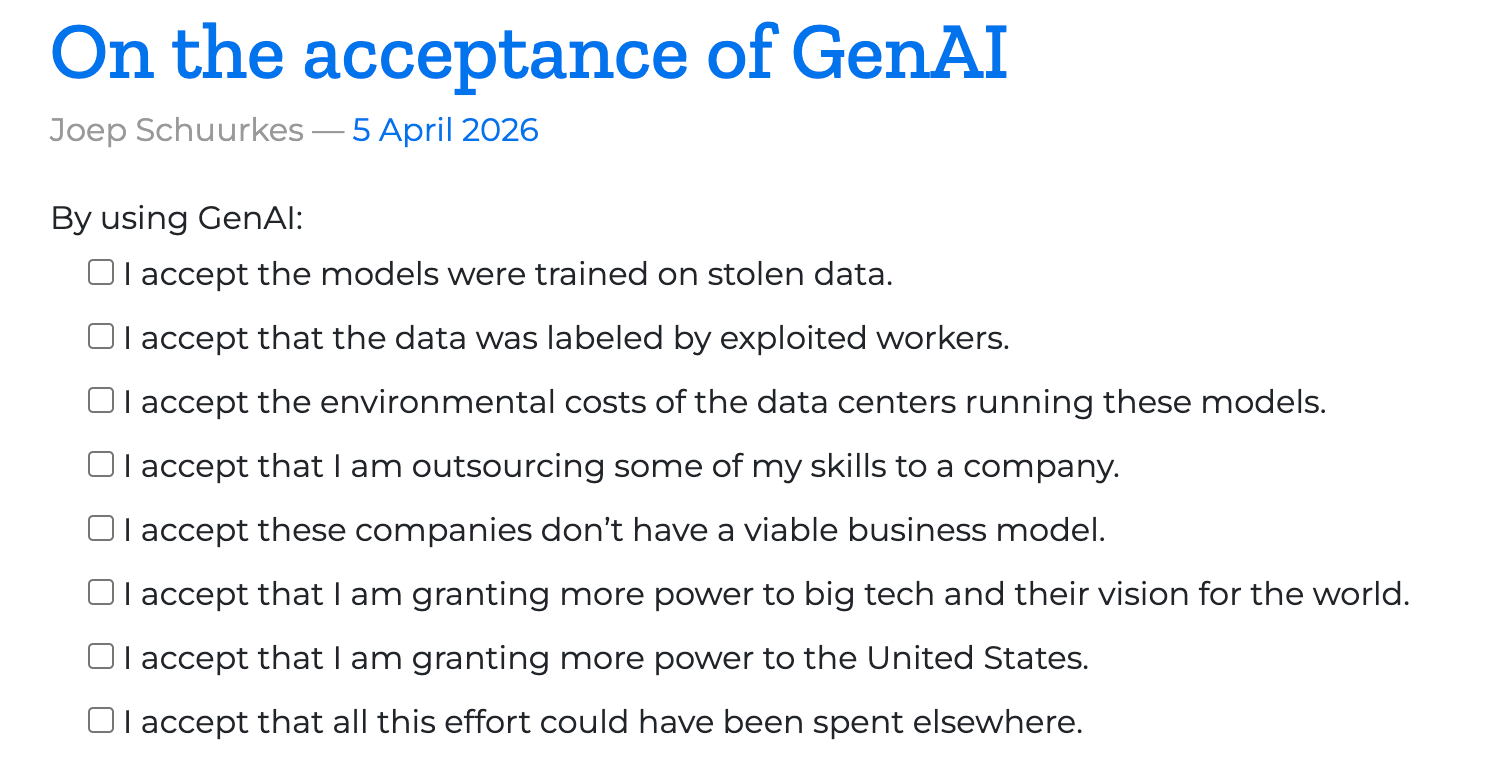
It reminded me of the "terms of use" for AI that programmer Joep Schuurkes posted online last week:
On trans people
Okay, now for something completely different: trans people exist! Not AI at all, but then again, it is, because like all discourse these days, the digital world is involved in everything. Trans people, just to be clear, are people who identify with a gender different from the one they were born with. Sometimes they feel this so strongly that they also want to live as someone of a different gender. That's it.
It's so tempting to think that being mean to trans people is normal, and has always been that way. But there used to be much more acceptance, in Goede Tijden from the '90s, for example (A Dutch soap opera)! A lot of stereotypes come up—"What should I bring [for the trans woman in question], a bouquet of flowers or beer?" says character Arthur—but in the end, she's accepted for who she is.
In America, they were ahead of the Netherlands; they handled it quite reasonably in a 1982 episode of The Love Boat! There, too, prejudices are voiced ("I don't know anything about 'that kind' of people"), but in a significant part of the episode, another character stands up for the trans woman, leading to remorse, understanding, and acceptance. And in Twin Peaks from 1990, there's a trans character, played by David Duchovny, who is an FBI agent and whose backstory matters very little. Someone calls her by her former name once, says sorry, case closed. "Look, these people exist," says David Lynch, "and we just adapt. It wasn't that hard, after all. Because what does it ultimately matter to me how someone else dresses, presents themselves, and wants to be addressed? If someone says "My name is Benjamin, but just call me Ben", don't you just do that without a second thought?"
Seriously, look at those quotes above—it's surprising how the world is now more narrow-minded and no better than it used to be.
So how did this suddenly become such a big deal? Well, that's where (social) media comes into play. People didn't just wake up one day and start fretting about it; this is a manufactured panic, a moral panic, led by prominent figures like J.K. Rowling, and the media, particularly the New York Times. If you want to read more about this, check out those articles; they're both from Assigned Media, a blog that highlights trans issues. My friends from the If Books Could Kill podcast have also dedicated an episode [[12]] to it, and those episodes also show how social media uproar has literally made its way into legal texts!
What you can learn from this case—and what was recently explained crystal clear in NRC, thankfully—is that you must not engage in discussions with the far right (in the Dutch case, FvD). You can't win against someone who doesn't play by the rules. We think there's a debate going on, a conversation in which the other side also wants to see your side of the story, especially if you back it up with (scientific) arguments. But they don't care; they are doing it for your anger and won't change, as the incomparable AR Moxon says:
"Meet me in the middle," says the unjust man.
You take a step toward him. He takes a step back.
"Meet me in the middle," says the unjust man.
This dynamic is playing out right before our eyes here as well. Plasterk (a biologist, for God's sake!) is still allowed to talk in Telegraaf about mutilating trans people (not sure this is the right word, he uses a specific Dutch slur). And with so much venom, opening with:
Women have two X chromosomes, men have X and Y; men have a penis, testicles, and produce sperm; women have fallopian tubes, a uterus, and breasts (translated)
Then he quickly adds that "there are individuals who have an abnormal number of sex chromosomes, and also individuals with an abnormal body shape"—and he even throws in a word that's outdated and offensive to intersex people. Fortunately, Tim Hofman thoroughly debunked this (Dutch also) "This isn't debating," he says, "this is firing shots and then ducking away." Indeed, targeting a very small segment of humanity that already has a hard enough time without that bullying. Even if you believe, as Plasterk says in his piece, that trans people would be better served by therapy than by surgery, do you really have to deliberately use derogatory words? That doesn't sound like someone who genuinely wants to help...
And De Telegraaf does this all the time. During "Spring Fever Week" (a Dutch national sexed week for schools) they preach "respect," but are you still allowed to think differently about gender?, they published as a letter to the editor from Geert-Jan Edelenbosch. I don't know exactly what his credentials are, but if you look up his name, you'll only find anti-LGBTQ opinion pieces, not just in De Telegraaf but also in NRC, Trouw, and on Radio 1. That alone, you'd think, would be reason enough for editors to take a critical look at such a piece: who is this person, and what is his goal? Do better, editors. The headline actually says it all (which is just as well, because the rest is behind De Telegraaf's paywall, which isn't easy to crack), but if you read the article itself, you see a so-called balance:
Respect must be mutual. [...] In a free society, respect means recognizing each other as human beings, without having to agree or give up your own perspective. That is precisely why there must remain room to think differently.
There must remain room to think differently—yes, it sounds so good, you can hardly disagree with it. But you can, and in fact, you must. Because your freedom of speech ends where it infringes on another's freedom, and if you demand respect for your opinion—which holds that we shouldn't even tell children that trans people exist (we've all imagined Nikkie De Jager friends; she doesn't actually exist at all!)
But anyone who says "this happens" is already taking a step: a feeling takes on a specific meaning—that it says something about someone's gender. This shifts the starting point. No longer is the body the basis, but its interpretation. (translated from Dutch)
It's really there: saying "this happens" is already a step ("too far" is, of course, implied), and we must treat that opinion with respect. Nein, danke!
[[12]]: Unfortunately behind a paywall, but I have a premium subscription, and I can really recommend it!
And there's this
- This timeline, friends! Who would have thought we'd ever would be laughing at LEGO videos where Iran makes fun of America? Not me! Mindbloding interview by the BBC with one of the creators of the viral hits.
- Hilarious piece from Vremde Mirror (a Flemish version of The Onion) Meta and Google want to ban kids: 'World with social media too dangerous'
- Article in Le Monde about the conference in Luxembourg where I presented my latest paper with a quote from me!
Felienne Hermans from the University of Amsterdam [tough luck] got straight to the point and criticized a situation many participants had experienced. Using humorous drawings, she described her attempt during her PhD research to transcend her field, pure computer science, and explore the humanities… She was then told that this was "not computer science." From this, she constructed a humorous, negative definition of her discipline: "What keeps the field going is that people are afraid of being excluded from it!" (Translated using Google Translate because my French isn't great, but aside from my university, it's pretty much spot on! If you have a better translation, I'd love to hear it.)
- Oopsie... If you use AI for your book review, you might accidentally steal one from someone else (yes, that's what happens when the models simply memorize language). And that'll cost you your job....
In January, Preston asked an LLM tool to expand a draft of a review he had written of Jean-Baptiste Andrea's Watching Over Her. According to his account, he did not realize that, in the process, the program took a few lines almost verbatim from Christobel Kent's Guardian review of the book, first published in August.
Events in English
- Friday, April 24 at the EUR at the Sectorplan SSH-Breed conference (English)
- Friday, June 5, at TU/e, I'll be on a panel about the future of peer review (English)
- Wednesday, June 9, I'll be speaking in Antwerp at DDD Europe (English)
Good news
Only for the nerds: a detailed report on how programmers used Claude and their own specification tool to track down a bug in decades-old Apollo code. This even strikes me as a very harmless application of LLM—you're not writing code, but rather looking for patterns, which you then feed into another tool that actually checks them (taking Schuurkes's points into account, of course!)
Yes, people are, very, very cautiously but still, reading more, according to ReactorMag, which quotes PublishersWeekly:
"For the second consecutive year, unit sales of print books were up at outlets that report to Circana BookScan, hitting 762.4 million in 2025 for the year ended Dec. 27, 2025. That marks a 0.3% increase over 2024, which in turn saw sales grow 0.5% over 2023."
France is switching to Linux—who would have thought?! Maybe 2027 will be the year of Linux on the desktop!
Nous devons nous désensibiliser des outils américains et reprendre le contrôle de notre destin numérique -->(Google Translate: We need to desensitize ourselves to American tools and regain control of our digital destiny.)
Better than our Dutch government, which is still fumbling around with DigiD. Bert Hubert and Barbara Kathmann spoke about this (in Dutch) and more on EenVandaag this week! (oops, now I'm accidentally moving into to the bad news section)
Bad news
More and more newspapers and magazines are blocking the Wayback Machine's archiving bot, which is bad news because it's precisely by properly archiving the internet that they can do their work! That's really necessary, because with fewer and fewer public archives
the work of safeguarding journalism's record increasingly falls to the Internet Archive
Oh look, conservative students (in America) do feel at home at university! All that fuss over nothing (but not for nothing, because of course this influences the public debate, even in the Netherlands!)
No language models were harmed in the making of this newsletter. And enjoy your sandwich!
Member discussion