
AI in week 3

You can find the English translation here (no longer at the end of the email newsletter, apparently that get's cut off for long emails)
Leukste nieuws eerst...!
Ik ga een boek schrijven! Ik heb gisteren mijn contract getekend om bij De Geus een boek te gaan schrijven. Waarom De Geus? Ik heb een paar uitgevers gesproken, en ze hebben het er allemaal over dat je een goede klik moet hebben de uitgever, maar ja, hoe weet je dat na een gesprek al. Het voelde een beetje als daten!
Maar één feitje hielp mij over de streep: Uitgeverij De Geus is opgericht door een echtpaar en hebben sinds hun oprichting in de jaren '80 altijd evenveel vrouwen als mannen uitgegeven. Jammer trouwens dat dat tweede feitje wel, maar dat eerste niet op hun Wikipedia-pagina staat. Dat past natuurlijk naadloos bij mijn visie, en daar was toen—en is nu misschien ook nog wel—lef voor nodig.
De werktitel van mijn boek is "Vierkante ogen: hoe informatici naar de wereld kijken" en de bekende thema's die je hier ook iedere week leest komen er zeker in terug: hoe informatica van een breed en interdisciplinair vakgebied langzaam wiskundiger werd, hoe verweven informatica en libertarisme altijd zijn geweest, hoe prat programmeurs gaan op complexiteit, en wat voor soort kennis in informaticacurricula structureel ontbreekt.
Nog niet eens zo heel lang geleden dacht ik dat computers beter leren snappen mensen zou wapenen tegen de onzin van Silicon Valley, als mensen zelf zien hoe makkelijk programmeren is, dan zien ze wel in hoe manipulatief hun Instagramfeed is. Maar dat viel dus tegen.
Nu denk ik dat ik beter de denkwijze van "computer people" kan uitleggen dan van de computers zelf, omdat ik, als ik er in lezingen over vertel, ik zo vaak hoor dat mensen het na een half uurtje echt snappen. Het inzicht van de hoge, koude, gletsjers, toegepast op de informatica helpt onmiddellijk je begrip, terwijl het toch een hoop tijd kost om een beetje Python te leren.
Dat laatste blijft ook een goed idee, als je je echt wilt bevrijden van Silicon Valley moet je meer zelf kunnen, maar omdat dit effectiever kan (ik denk aan een woord of 50.000 wel genoeg te hebben), ga ik dat nu toch eerst doen!

DigiD in Amerikaanse handen
Nou, schreef ik vorige week kort over onderzoek van FTM naar de overname van DigiD, deze week ben ik er zelf volop mee bezig geweest zoals je misschien gezien hebt bij EenVandaag of in de Volkskrant!
De overname van Solvenity door het Amerikaanse Kyndryl is namelijk nog niet definitief, dus nu heeft het nog zin om je er druk over te maken. Het is namelijk niet zomaar wat, DigiD wordt inmiddels door heel veel verschillende partijen gebruikt, hetgeen trouwens ook weer tot allerhande nieuwe problemen leidt, omdat het daar niet voor bedoeld was. Als DigiD het het morgen niet meer doet, dan kan ik niet overzien wat er allemaal vastloopt, maar in ieder geval belastingaangiftes, Sociale Verzekeringsbank, gemeentes, en zorgafspraken. Dat lijkt me heel wat chaos geven.
En daar ligt dan ook voor mij de grootste zorg, dat Amerika als wij iets doen dat ze niet bevalt, ze DigiD als straf of pressiemiddel plat kunnen leggen. Zoals we ook schrijven in het stuk:
Als een deel van onze vitale digitale infrastructuur in Amerikaanse handen wordt gelegd, vergroot dit de kwetsbaarheid van Nederland voor uitval, manipulatie of zelfs chantage.
Zouden we zomaar de software die onze bruggen, sluizen en waterkeringen beheert afstaan, nee toch? Waarom dan voor digitale infrastructuur wel? Een paar jaar terug zou zoiets misschien hebben geklonken als de angsten van een anti-overheidswappie, maar het gebeurt al, bijvoorbeeld bij het Internationaal Strafhof waar Microsoft een mailbox blokkeerde (waarna ze trouwens overstapten naar het Duitse openDesk en ook op universiteiten klinkt deze oproep steeds vaker).
Een andere terechte zorg is uiteraard dat de Amerikanen bij onze data kunnen, dat mogen ze namelijk onder hun eigen CLOUD-act, die iedere Amerikaanse burger kan opleggen om data aan de overheid te overhandigen, ook als die data niet eens in Amerika staat.
Het artificiële onderscheid dat onze staatssecretaris probeert te maken tussen de software enerzijds (die Nederlands blijft) en het platform waarop deze draait (die dus overgenomen wordt) doet voor de Amerikaanse wet niet ter zake, en door de dreiging van uitzetten ook niet.
AI-vertroebeling
Mooi nieuw woord kwam ik van de week tegen: "AI vertroebeling". Het idee, waar ik zelf natuurlijk ook steeds over schrijf, dat simpelweg door het bestaan van AI, alles gewantrouwd moet worden. Het deed met denken aan een oud stuk uit New York Times, uit oktober 2024 alweer, waarin jongeren bevraagd werden over hun relatie met het nieuws:
The news should be the one thing I can trust, but oftentimes it is not. Therefore, I do not look at the news. The news is often fake, and trusting any source is hard these days.
Je ziet hier goed dat jongeren in de basis nieuws echt vertrouwen, of althans weten dat dat zo zou moeten zijn. Dat is ook in lijn met mijn eigen ervaring, mijn leerlingen op school vinden het écht nog wat betekenen als ik in de krant sta of op de ouderwetse lineaire tv ben, zelfs als ze het niet zelf consumeren. Ze zien dat vertrouwen echter, vaak terecht denk ik, niet omgezet in kwaliteitsnieuws. Dus misschien moet traditionele media niet investeren in zijn waar de jongeren zijn zoals TikTok, maar in de plekken waar ze zouden willen en moeten zijn, zoals de krant.
De bubble
Afgelopen zomer las ik het boek The Cult of We, dat nog dieper ingaat dan de serie WeCrashed, die ik ook al smullen vond. Wat je ziet in de serie en in het boek is vooral het totale over de top vertrouwen dat zelfs serieuze instanties zoals banken hebben in mensen met een grote bek. Had oprichter Adam Neumann het gewoon gehouden bij een hippe kantoorruimteverhuurder, dan had hij concurrent Regus eenvoudig naar de kroon kunnen steken omdat zijn slimme marketing het idee van kantoorruimte superhip maakte. Knap, op zich om iets saais heel spannend te maken! Maar hij wilde meer: eindeloze groei, en zich kunnen meten met techbedrijven.
Het deed me ook denken aan het ongeveer waargebeurde verhaal van Inventing Anna. Had die met het krediet dat ze kreeg iets kleins gedaan, een simpele kunstgalerie starten ofzo, had ze er best iets winstgevends van kunnen maken, maar als je steeds maar meer wilt, knapt het op een bepaald moment. Net als de Beanie Baby bubbel.
Als je net als ik heb gesmuld van het WeWork verhaal, dan heb ik slecht nieuws voor je (of goed nieuws, wie weet komt hier over een paar jaar ook een heerlijke docu of seri over!). OpenAI is, aldus de Economist:
the WeWork story on steroids
OpenAI moet van alles proberen om relevant te blijven, zo lanceerden ze vorige week ChatGPT Health, omdat mensen chat vaak gebruiken voor gezondheidsadvies, met daarin fikse claims over veiligheid (nadruk van mij)
We introduceren ChatGPT Health, een aparte functie die je gezondheidsinformatie en de intelligentie van ChatGPT veilig samenbrengt, zodat je beter geïnformeerd en voorbereid met je gezondheid omgaat.
Wat betekent veilig hier? Dat je data niet gedeeld wordt, of dat je gegarandeerd veilig advies krijgt? Dat is wel even want anders, en dat laatste kan natuurlijk niet, want ook deze vorm van ChatGOT leidt aan hallucinaties. Maar ja, zo zeggen ze er natuurlijk snel nog even bij: "Het is niet bedoeld voor diagnose of behandeling." Goed, maar waarvoor dan wel?
Meester, meester, ik weet het antwoord! Het is bedoeld om te laten zien hoe relevant ze zijn, en hoe ze innovatief nieuwe features uitrollen, precies zoals Neumann op het einde van WeWork benadrukte dat ze geen kantoorruimte verhuurden maar een innovatief tech bedrijf waren.
Maar kan bruin dat trekken? The Economist schrijft dat Altman dit jaar nog $100 miljard nodig heeft, omdat hij wel omzet draait, maar dat dat niet (bijna) gratis gaat zoals bij andere techbedrijven, die met een redelijk eenvoudig product enorm konden opschalen:
The trouble is that OpenAI’s demand for computing power—by far its biggest cost—has remained tightly coupled to revenue. The company’s computing needs grew from 200 megawatts in 2023 to 1.9 gigawatts in 2025.
En dat is niet het enige probleem. De vraag blijft steeds maar weer of LLMs nu echt iets opleveren... Zelfs bij Salesforce, die eerder nog 4000 mensen ontsloeg zijn ze nu minder enthousiast over AI dan een jaar geleden, zo zegt hoofd marketing Sanjna Parulekar, "after encountering reliability issues that have shaken executive confidence". Misschien was er iemand in een jaarverslag in een kikker veranderd? Ook bij Starbucks passen ze hun AI-positieve strategie aan en gaan ze weer meer medewerkers aannemen:
What we're finding is that [removing labor from the stores, with the hope that equipment could offset the removal of the labor] wasn't an accurate assumption with what played out.
Worden er dus "door de opkomst van AI" mensen ontslagen? Ja dat is zeker gebeurt bij Salesforce en bij StarBucks, maar dus niet zozeer door het inzetten van AI, alswel door de belofte ervan. AI lijkt dan, zo lezen we zelfs op nu.nl, eerder een veelgebruikt excuus voor ontslagen dan de directe aanleiding ervan.
Het is namelijk zo in deze wereld waarin we leven, ik snap het ook niet al weet ik het wel, dat als je mensen ontslaat, dat dat goed is voor je aandelenkoers. Mijn niet-economisch geschoolde brein zou het logisch vinden dat ontslagen slecht zijn voor de koers, want als je er mensen uit moet gooien, loopt je tent toch niet lekker. Maar de wereld van hyperkapitalisme werkt anders, en als je als eigenaar dus je beurskoers wilt opkrikken moet je mensen ontslaan, en als je daar ook nog eens een fijne, moderne, technologische reden voor hebt, dan houdt "de markt" van je. (Het gaat blijkbaar nog te ver om openlijk te zeggen dat je mensen ontslaat met als hoofddoel de koers op te vijzelen).
Nog lezen over de grote bubbel-pop van 2026? MIT Technology Review maakte eind vorig jaar een overzicht van vier grote stukken over de correctie van de hype die eraan gaat komen.
Samenwerken
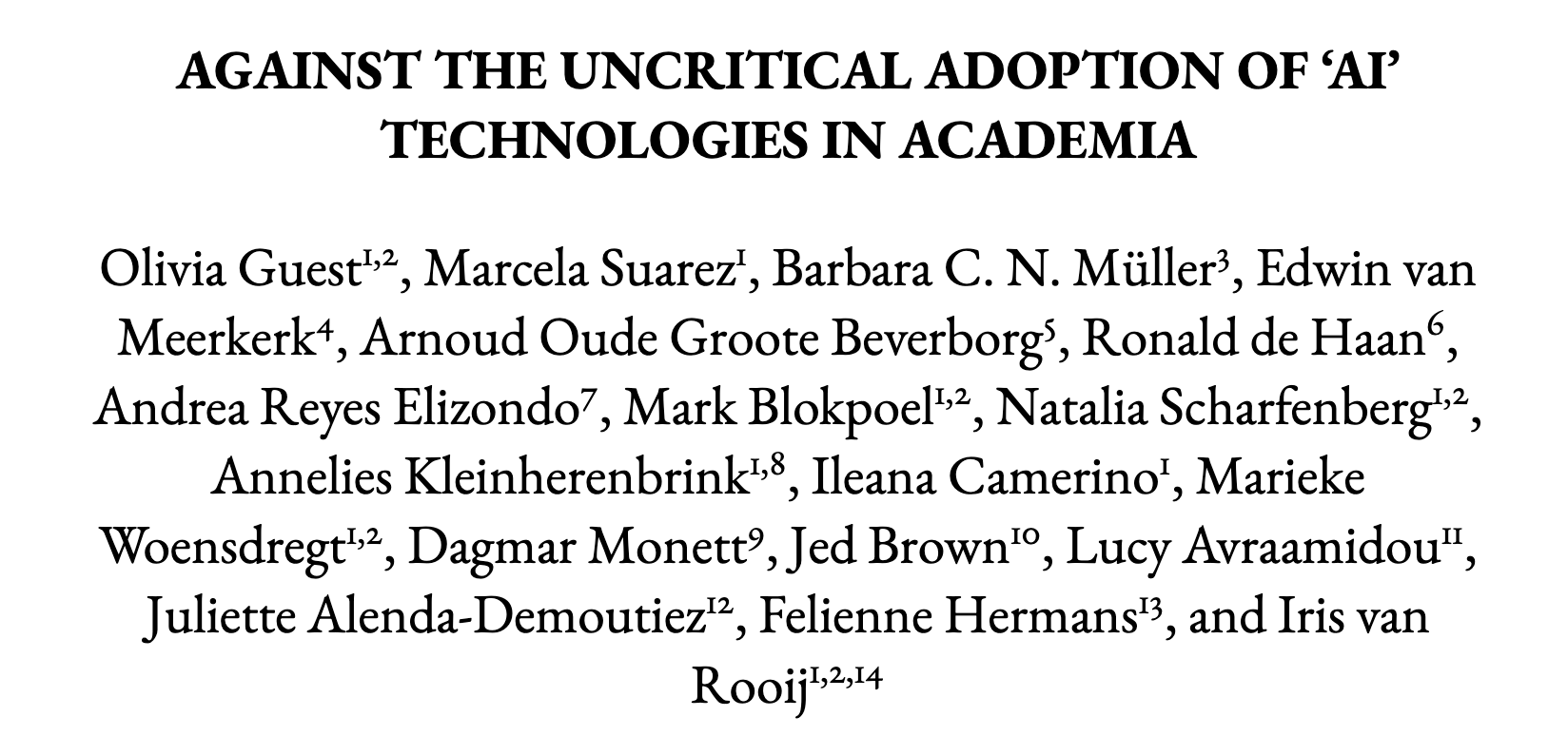
Wat betekent het om iets samen te doen? Vorig jaar las ik daarover een fascinerend paper van VU-collega Jeroen de Ridder getiteld: How Many Scientists Does It Take to Have Knowledge? Dat klinkt als het begin van een mop over het indraaien van een peertje, maar dat is echt een serieuze vraag. Traditioneel, zo legt de Ridder uit, hebben we kennis gezien als iets dat zich in precies één hoofd bevindt. Als we een boek lezen van Aristoteles of van De Beauvoir of Descartes, dan kunnen we probleemloos aannemen dat wat daar staat, kennis was die zij hadden, die ze door hun hoofd hadden laten rollen en zelf schreven. Maar wat moet je met een paper zoals deze recente, waar ik ook aan meeschreef? Maar liefst 18 auteurs hielpen aan dit paper, maar welke kennis hebben wij over wat er staat?
En zo heb ik talloze papers op mijn cv staan, papers die ik niet alleen schreef maar met een groep van variërende samenstellingen. Papers van twee auteurs waar ik de promotor was en dus als een soort orakel op afstand af en toe bijstuurde, maar ook papers van twee auteurs waarbij we ik met een andere professor op heel gelijke voet en heel intensief samenwerkte. Je kan aan zo'n paper niet zien wie er welke kennis heeft bijgedragen (al experimenteren sommige tijdschriften tegenwoordig met kleine bijsluitertjes waarop je kan aangeven wat je rol in het paper was). Kan je als groep wel auteur zijn? De Ridder zegt dat er best een case te maken is dat dat niet kan:
Groups don’t have minds of their own and, hence, no mental states. Since knowledge either is a mental state itself or at least involves one (to wit, that of belief), it follows immediately that groups cannot literally have knowledge. Case closed.
Maar gelukkig is de Ridder een praktisch mens, en neemt hij met deze argumentatie geen genoegen. Want, de realiteit is nu eenmaal dat de meeste papers die vandaag de dag verschijnen, door meerdere auteurs geschreven zijn, dus moeten we dit proces ook kunnen bestuderen. Zeker als je met mensen uit meerdere vakgebieden werkt, zeg een socioloog en een informaticus die samen conclusies trekken op basis van een dataset, dan heb je beide expertises nodig om de conclusie en het proces waarmee die tot stand kwam, te snappen en te verdedigen. Dat noemt De Ridder 'warrant':
If an instance of scientific knowledge is the result of practically or cognitively necessary collaboration, it will not only have been produced by a collective, but the warrant for it will often also be shared by the collective and the collective will be in a position to use this knowledge in a number of functional roles. [nadruk van mij]
En alhoewel mensen AI meestal alleen gebruiken, beïnvloedt het ook hoe mensen samenwerken op allerhande manieren. Want samenwerken is mensenwerk, en dat is niet het simpelweg bij elkaar zetten van een paar losse feitjes. Dit heel leesbare paper van onderzoekers van Harvard en Carnegie Mellon beargumenteert dat als mensen samenwerken, maar ze niet van elkaar geloven dat ze ook echt moeite hebben gestoken in het werk, dat de samenwerking dan toch spaak loopt.
Effectief samenwerken leunt namelijk op 'mental proof', bewijs dat je ook echt iets gedaan hebt, of in de woorden van de auteurs:
Mental proofs are observable actions taken to certify unobservable facts about the minds who perform them.
Dit is denk ik voor iedereen die op school wel eens een groepsproject heeft gedaan, meteen duidelijk, samenwerken werkt omdat je echt gelooft dat een ander moeite heeft gestoken in het werk. Op basis van de inzet van een ander, pas je ook je eigen inzet aan, en verdeel je taken in een project. Denk jij dat de ander echt zijn best gedaan heeft? Dan ben je misschien wel bereid meer bij te dragen dan als je denkt dat hij er nog wel een tandje bij kan zetten.
Maar juist dit, zo zeggen deze wetenschappers, dat werkt alleen als je ook echt moeite moet steken in het werk:
When AI makes generating high-quality text (and by extension, "ideas") effortless, it destroys this costly signal.
Als we niet opletten, dan maken we teams die wel sneller werken, maar elkaar minder vertrouwen (zo zegt het paper) en (zo vul ik zelf aan) ook nog eens minder weten over wat hun collega's weten en kunnen, wat het verdelen van werk in de toekomst ook nog eens lastiger maakt.
De abstract van dit paper sluit af met een hele mooie, en diepe vraag:
How do we signal deep understanding in a world where the output is automated?
Ja, hoe laten we zien dat we werk echt gedaan hebben, in een wereld waarin mensen bestaan die 113 papers in één jaar hebben geschreven? Het is voor mij niet te geloven dat de kennis in ieder van die 113 papers, zoals De Ridder het noemt, door deze auteur warranted is, zelfs als onderdeel van een groep lijkt me dat bij zoveel papers ondoenlijk. Of, zoals Peter Naur zo mooi beschrijft, hij voor ieder van de 113 papers een theorie heeft gevormd. Dat we hem kunnen bellen om:
to explain them, to answer queries about them, to argue about them, and so forth.
AI lost dat probleem niet op, sterker nog, het maakt het groter. Want het zorgt ervoor dan mensen nog meer kúnnen publiceren, wat normen verandert waardoor de druk nog groter wordt om meer te gaan publiceren, etcetera, etcetera.
Als mensen om je 100 papers schrijven, dan ben jij als individu gek als je het niet ook doet. Het systeem van kennis leidt hier natuurlijk onder, als we steeds meer schrijven maar steeds minder snappen, zei ik ook toen Aob me interviewde deze week.
Wiens taalmodel?
Schitterend mooi stuk van Marcus Olang dat over chatGPT gaat, maar ook over de invloed van kolonialisme op schrijven, hoe het Engels dat ze leerden in Kenia (en dit geldt natuurlijk ook voor andere plekken waar de Britten zaten) geen levende taal, maar een statische:
The English we were taught was not the fluid, evolving language of modern-day London or California, filled with slang and convenient abbreviations. It was the Queen's English, the language of the colonial administrator, the missionary, the headmaster. It was the language of the Bible, of Shakespeare, of the law. It was a tool of power, and we were taught to wield it with precision.
En juist dat soort taal, kaal, niet levend, vreemd formeel, dat is nu de taal van GPT geworden.
Vrouwenhaat op internet
Een jaar geleden werd ik gevraagd door Volkskrant of ik een stuk wilde schrijven over bias in AI, maar ik zei nee. k wil een stuk schrijven, zei ik, over hoe het internet al meer dan 10 jaar bol staat van georganiseerde vrouwenhaat. Bias in AI, dat kennen we zo onderhand wel, maar hoe het internet en technologie steeds weer gebruikt worden om vrouwen klein te houden, dat is een verhaal dat ertoe doet omdat het verborgen blijft. Het werd dit stuk, bijna een jaar oud dus nu, maar nog even relevant als toen.
Ik verwees erin naar het fenomeen Gamergate, een beweging die vrouwen op internet beledigde, doxxte, en bedreigde, maar nauwelijks aandacht kreeg in de media, na mijn stuk hoorde ik van veel mensen dat ze er nog nooit van gehoord hadden. Maar het was, in de profetische woorden van Amerikaanse journalist Kyle Wagner uit 2014, maar een voorbode van wat er op ons af zou komen:
a glimpse of how these skirmishes will unfold in the future—all the rhetorical weaponry and siegecraft of an internet comment section brought to bear on our culture, not just at the fringes but at the center. What we're seeing now is a rehearsal, where the mechanisms of a toxic and inhumane politics are being tested and improved.
En zo ging het precies. De verkiezing van Trump lag downstream van deze beweging. Wagner legde trouwens ook de vinger op de zere plek over wie hier blaam voor treft:
[Gamergate has] exploited the same basic loophole in the system that generations of social reactionaries have: the press's genuine and deep-seated belief that you gotta hear both sides. Even when not presupposing that all truth lies at a fixed point exactly equidistant between two competing positions, the American press works under the assumption that anyone more respectable than, say, an avowed neo-Nazi is operating in something like good faith.
En waar lazen we dit stuk dat met een glazen bol niet beter geschreven had kunnen worden? De New Yorker? De Atlantic? Nee... op de onbekende sportblog Deadspin. Dus ja, niemand luisterde (geen garantie trouwens dat dat op een ander platform wel was gebeurd natuurlijk), en ook nu weer nemen we de dreiging niet serieus.
Want zelfs nu het op X mogelijk is om iedere foto van vrouwen van hun kleding te ontdoen, waaronder foto's van actrice Nell Fisher van 14, is de berichtgeving erover, en de reactie erop, niet in de buurt van serieus genoeg.
"Uitkleedapps", noemt nu.nl ze, in plaats van wat ze zijn, tools waarmee je kinderporno kan maken, alsof het over een Barbie gaat met een plastic foef tussen de spillebeentjes, en niet om seksuele beelden van minderjarigen die met een snelheid van duizenden per uur langskomen. Tsja, het is ook allemaal zo complex, aldus onze demissionaire minister van justitie Van Oosten in dat stuk. Hoe complex precies?
Ah ja, te complex blijkbaar voor onze minister van buitenlandse zaken om niet meer op Twitter [[1]] te posten...! Eerst even kinderporno scrollen voor je kan lezen wat het officiele standpunt van Buitenlandse zaken over Groenland is, het klinkt als een aflevering van Black Mirror maar het is gewoon een random woensdag in 2026. Waarom zulke berichten niet minstens ook crossposten op BlueSky, waar ook een account bestaat?
God only knows what David van Weel would do without Twitter, blijkbaar. Ok, dus als overheid niet meer posten op Twitter, dat is niet de oplossing, wat dan wel volgens Van Oosten?
Een zorgvuldige afweging, samen met alle betrokken partijen, is noodzakelijk
Alle betrokken partijen?! Dat klinkt als gezellig babbelen met Muskie, toch? Die alle ophef natuurlijk allemaal maar censuur vindt. Of alle uitgeklede vrouwen even op de koffie vragen? Wat staat daar in godsnaam?
En het is nu niet zo dat landen niks doen, of niets kunnen doen. Je kan het gewoon blokkeren, zoals Maleisië and Indonesië wel gedaan hebben, en zelfs de recent erg techno-optimistische UK nu overweegt. Of dus minstens er niet meer op posten, dat hoeft echt van niemand Van Weel.
Het geeft weer eens goed aan hoe genormaliseerd seksueel geweld tegen vrouwen hier is, en hoe weinig indrukwekkend op mannen dat dit gebeurt, in welke vorm dan ook.
Het is ergens ironisch dat dé studie waarvan rechts (zelfs enigszins redelijk rechts) heeft besloten dat het zinloos is, en een teken van het verloederen van echte kennis, gender studies is, terwijl bijna alles wat we nu zien gebeuren—van de bedreigingen van vrouwen op internet, niet alleen via Grok, maar ook bijvoorbeeld met "smart" zonnebrillen, tot de langgekoesterde wens van Peter Thiel op vrouwenstemrecht terug te draaien—beter te snappen is vanuit man-vrouw dynamiek en de geschiedenis van.
[[1]]: Vertik dat ik het ooit X ga noemen!
De lezersvraag: Wat vind je van dit stuk?
Of eigenlijk was de vraag van Lennart Quispel, over dit stuk, nog wat scherper:
Nou, @irisvanrooij.bsky.social en @felienne.bsky.social ... deze verzameling drogredenen vraagt wel om een scherpe reactie. www.volkskrant.nl/columns-opin...
— Lennart Quispel (@lquispel.bsky.social) 2026-01-14T10:24:45.530Z
Wat moeten we hier nu weer over zeggen? Ik kan het misschien kort houden, want de altijd scherpe Hans Schnitzler kwam al met een fijne repliek.
Maar ik ga toch nog even een duit in het zakje doen, en dan begin ik bij het boek van Lode Lauwaert, dat ik door een samenloop van omstandigheden afgelopen herfst las. Ik kan zijn boek echt aan niemand aanraden, en dat begint al bij de titel "Wat niemand je vertelt, zelfs chatGPT niet". Los van dat deze titel taalmodellen weer eens antropomorfiseert—alsof het jou uit vrije wil kennis onthoudt—is het clickbait waar de gemiddelde Facebookspammer zijn vingers bij af kan liggen. Deze ene afvaltip houden zelfs dokters geheim!
En die titel wil ik je nog best vergeven, we moeten als wetenschappers toch zorgen dat onze boodschap landt bij een groot publiek, als er dan ook maar een nieuw snippertje kennis in het boek had gestaan. Heeft Lauwaert maandenlang vermomd als conifeer bij Alsman in de tuin gestaan om ons geheimen te vertellen? Heeft hij diepte-interviews gehouden, historische analyze gedaan? Niets van dat alles, het boek is een simpele kopieeroefening van het AGI-is-coming-verhaal uit de Valley, met in plaats van echte gedachten en citaten van filosofen een verzinnen dialoogje tussen twee fictieve mensen tussen wie de lezer moet kiezen.
Kijk ik ben geen techniek-filosoof (al zei een bekende techniek-filosoof laatst tegen mij dat ik me inmiddels wel gedraag als techniek-filosoof en toen liep ik twee weken naast mijn schoentjes!) maar ik denk dat we mogen verwachten van Lauwaert dat hij ons in zo'n boek nieuwe perspectieven biedt. Dat hij hypothetiseert niet over hoe verzonnen Thomas en Nadia, of zijn eigen kind als volwassene naar AI in 2026 kijken, maar Plato, Descartes, Weil, Arendt of wie dan ook. In plaats daarvan worden we getrakteerd op Bostrom en MacAskill, die niet alleen geciteerd worden maar ook bedankt, naast Eliezer Yudkowsky [[2]]. Ik zou willen zeggen, dan weet je uit welke hoek de wind waait, weet je dat niet, dan kan je te rade bij dit goede stuk van Laurens Verhagen.
Lauwaert is gewoon superpositief over A(G)I, en heel kritisch op tegenstanders zoals Timnit Gebru en Melanie Mitchell, want, zo zegt hij, zij schrijven anderen bedoelingen toe (bijvoorbeeld dat ze met hype-verhalen over AGI de aandacht afleiden van onmiddellijke problemen zoals bias en klimaat afleiden). En je weet helemaal nooit wat een ander denkt! Ja, koekoek, dan kan je nooit iemand iets verwijten.
Maar goed, even naar zijn Volkskrant-stuk. Want de belangrijkste kritiek die hij in het stuk uit, is dat wij, de tegenstanders van AI, vooringenomen zijn. Alsof er een hele waaier aan argumenten voor en tegen is, en wij, gemenerds, steeds alleen de "tegen-kaarten" spelen. Moeten die zeurderige geesteswetenschappers niet eens meer zijn als de beta's?
Waar techneuten nog spreken over doorbraken en efficiëntiewinst, gaat het bij menswetenschappers al snel over ethische problemen: bias, discriminatie en privacyschending.
Je mag mensen dus blijkbaar nooit gedachtes toeschrijven, maar je zou toch bijna denken dat deze man beter lekker informatica had kunnen gaan doen.
Er ontstaat volgens hem zo een eenzijdig debat. Dude, kom je wel eens op Linkedin? De voordelen vliegen je om de oren, als het niet van big tech zelf is, dan is het wel van een leger influencers, goeroes en zelfs AI-magiers (ik verzin dit niet). En alsof het zo leuk is om deze kant van het debat te kiezen, je hebt voortdurend last van gezeur aan je kop. Ik kan geen lezing geven zonder dat er wel mensen zijn die mij vragen om ook over de voordelen te praten, en dan is de schade voor mij nog mild, Gebru en Mitchell verloren hun baan omdat ze zo kritisch zijn.
En is Lauwaert dan zelf een neutrale budda in AI-land? Ok, ik doet het mezelf aan maar ik pak toch nog even zijn boek erbij:
Mijn oordeel over chatbots en generatieve AI is zéér positief. Ik vind de hype terecht.
Dat mag natuurlijk, je mag fan zijn, je mag het supercool vinden, je mag geloven dat AGI eraan komt, echt. Maar dan ben je toch wel een meelmondje als je dan een ander verwijt eenzijdig te denken. Maar goed, geloof niet mijn kritiek, geloof die van hemzelf (ook uit zijn boek).
Er is zoveel dat je met [moderne LLMs] kan doen. Het gaat bovendien veel sneller. En de output is vaak veel beter dan wanneer ik het zelf zou doen. En niet in het minst: ik heb nu nauwelijks zélf iets moeten doen. [dikgedrukte nadruk van mij, accenten origineel]
[[2]]: Het wordt uit de formulering trouwens niet duidelijk of hij deze mensen persoonlijk kent, of dat hij hen alleen als inspiratiebronnen noemt.
Slecht nieuws
Afgelopen week was de CES, de Consumer Electronics Show, ooit een plek waar coole nieuwe tech gepresenteerd werd, nu voornamelijk... AI-slop. De prijzen voor de slechtste ideeën gingen onder andere naar een lolly die muziek afspeelt als je 'm opeet (?) en een koelkast die open gaat als je "open" zegt. Handig als straks al je apparaten dat hebben en open tegelijk je oven, vaatwasser, vriezer en wasmachine opent.
De oceanen worden alsmaar warmer. De onderzoeker die daarover een paper schrijft noemt de situatie "bonkers":
"Last year was a bonkers, crazy warming year—that’s the technical term," Abraham joked to me. "The peer-reviewed scientific term is ‘bonkers’."
Hij komt metaforen te kort om uit te leggen hoeveel de oceanen warmer worden, het beste dat hij kan verzinnen is dat de energie die in 2025 in de oceaan verdween gelijk staat aan 12 Hiroshima bommen, of de energie die nodig zou zijn om 2 miljard zwembaden te laten koken, of meer dan 200x alle energie die iedereen op de wereld gebruikt. Het zijn allemaal gigantische maar ook abstracte manieren om uit te leggen dat het echt echt heus, niet best gaat. Zelfs als we nu zouden stoppen met olie en gas, dan blijft deze opwarming nog honderden jaren doorwerken, zo sluit het artikel in Ars Technica af.
Google stopt Gemini in Gmail en alle andere apps (en kan dan jouw data gebruiken om meer AI te trainen!) Lees hier hoe je het uitzet! In de EU staat het standaard uit—dus zeg niet dat we niks kunnen doen tegen de giganten—maar, als de smart features uitstaan, kan je geen priority inbox meer gebruiken! Dan wordt Gmail in praktische zin zo goed als onbruikbaar, want dan komen al je random nieuwsbrieven tussen je belangrijke mail te staan. Voor mij 1) een overduidelijke vorm van chantage want ook zonder deze AI hadden we priority inbox al, dus het is er echt niet voor nodig, 2) de laatste druppel om mijn gmail te verlaten.
Goed nieuws
Net alleen ouders en ouderen zijn kritisch over social media, ook sommige zoomers begrijpen de problemen maar wat goed.
Kunnen we niet beter lezen dan scrollen? Ja, zegt dit onderbouwde stuk in Metro (ik wist niet dat ze nog bestonden, trouwens). Lezen zorgt ervoor dat mensen zich meer verbonden voelen met anderen. Gek maar waar, denk ik, sociale media zijn misschien wel heel veel minder sociaal dan alleen een mooi verhaal lezen!
Het internet is dood? Misschien, maar er zijn ook nog te gekke plekken, zoals deze website die cassettebandjes digitaliseert die je ze stuurt.
Events, voor in de agenda
- Vrijdag 6 februari kan je me zien in Theater ZIMIHC in Utrecht waar ik Theatergast ben!
- Zondag 8 februari ga ik in Artis het gesprek aan over AI.
- Dinsdag 10 februari kan je met mij meedoen met de boekenclub van Filosofie in Actie! Je kent ze misschien van de hele leuke podcast die ik met ze opnam deze zomer. We bespreken het boek De Grote Weigering van Marian Donner, maar dat hoef je vooraf niet te lezen.
- En natuurlijk op donderdag 12 februari eerst bij de NLT conferentie en dan bij NWO!
Geniet van je boterham, en misschien nog even van dit doldwaze en gelukkig goed aflopende avontuur van een bobsleeër die alleen in een viermansbob eindigt!
English
Coolest news first...!
I'm going to write a book! Yesterday, I signed my contract to write a book with De Geus. Why De Geus? I spoke to a few publishers, and they all said that you need to have a good 'click' with the publisher, but how can you know that after just one conversation? It felt a bit like dating!
But one fact helped me make up my mind: De Geus was founded by a husband and wife and, since their start in the 1980s, has always published an equal number of women and men. It's a shame that the second fact is on their Wikipedia page, but not the first. That fits in perfectly with my vision, of course, and it took—and perhaps still takes—guts to do that.
The working title of my book is "Square Eyes: how computer scientists view the world" [[2]] and themes that you read about here every week will certainly be reflected in it: how computer science slowly became more mathematical from a broad and interdisciplinary field, how computer science and libertarianism have always been intertwined, how programmers boast about complexity, and what kind of knowledge is structurally missing from computer science curricula.
Not so long ago, I thought that computers learning to understand people better would arm people against the nonsense of Silicon Valley. If people saw for themselves how easy programming is, they would realize how manipulative their Instagram feed is. But that turned out not to be the case.
Now I think I can better explain the mindset of "computer people" than that of computers themselves, because when I talk about it in lectures, I so often hear that people really understand it after half an hour. The insight of the high, cold glaciers, applied to computer science, immediately aids your understanding, whereas it takes a lot of time to learn a little Python.
The latter remains a good idea; if you really want to free yourself from Silicon Valley, you need to be more self-sufficient, but because this can be done more effectively (I think 50,000 words should be enough), I'm going to do that first!
[[2]]: In Dutch, your parents would warn you that by watching tv and being on the computer too much, you'd get "square eyes". If the book will appear in English, I will have to come up with another clever title!
DigiD in American hands
Well, last week I wrote briefly about FTM's investigation into the takeover of DigiD, and this week I've been working on it myself, as you may have seen on EenVandaag or in de Volkskrant (in Dutch).
The acquisition of Solvenity by the American company Kyndryl is not yet final, so it still makes sense to be concerned about it. It's not just any old thing, DigiD is now used by many different parties, which, incidentally, also leads to all kinds of new problems, because that's not what it was intended for. If DigiD stops working tomorrow, I can't foresee all the problems that will cause, but it will certainly affect Dutch tax returns, the Social Insurance Bank, municipalities, and healthcare appointments. That seems like it would cause a lot of chaos.
And that is my biggest concern: that if we do something America doesn't like, they can shut down DigiD as a punishment or a means of pressure. As we also write in the article:
If part of our vital digital infrastructure is placed in American hands, this increases the Netherlands' vulnerability to failure, manipulation, or even blackmail (translated from Dutch)
Would we just hand over the software that manages our bridges, locks, and Deltawerken? No, right? So why would we do that for digital infrastructure? A few years ago, something like this might have sounded like the fears of an anti-government nutcase, but it's already happening, for example at the International Criminal Court, where Microsoft blocked a mailbox (after which, incidentally, they switched to the German openDesk, and this call is also being heard more and more often at universities) (all links in Dutch).
Another legitimate concern is, of course, that the Americans have access to our data, as they are allowed to do so under their own CLOUD Act, which allows any American citizen to compel the government to hand over data, even if that data is not even located in America.
The artificial distinction that our Secretary of State is trying to make between the software on the one hand (which remains Dutch) and the platform on which it runs (which is being taken over) is irrelevant under American law, and also irrelevant due to the threat of deportation.
AI distortion
I came across a nice new word this week: "AI distortion". The idea, which I myself write about all the time, is that simply because AI exists, everything must be distrusted. It reminded me of an old article from the New York Times, from October 2024, in which young people were asked about their relationship with the news:
The news should be the one thing I can trust, but oftentimes it is not. Therefore, I do not look at the news. The news is often fake, and trusting any source is hard these days.
Here you can clearly see that young people basically trust the news, or at least know that they should. This is also in line with my own experience. My students at school still think it means something when I'm in the newspaper or on old-fashioned linear TV, even if they don't consume it themselves. However, they see that trust, often rightly so I think, not being converted into quality news. So perhaps traditional media should not invest in where young people are, such as TikTok, but in the places where they would like to be and should be, such as the newspaper.
The bubble
Last summer, I read the book The Cult of We, which goes even deeper than the series WeCrashed, which I also enjoyed. What you see in the series and in the book is mainly the totally over-the-top trust that even serious institutions such as banks have in people with big mouths. If founder Adam Neumann had just stuck to being a trendy office space rental company, he could have easily surpassed his competitor Regus because his clever marketing made the idea of office space super trendy. Impressive, in itself, to make something boring very exciting! But he wanted more: endless growth, and to be able to compete with tech companies.
It also reminded me of the semi-true story of Inventing Anna. If she had done something small with the credit she received, like starting a simple art gallery or something, she could have made it quite profitable, but if you always want more, at some point it will all come crashing down. Just like the Beanie Baby bubble.
If, like me, you enjoyed the WeWork story, then I have bad news for you (or good news, who knows, maybe in a few years there will be a great documentary or series about it!). According to The Economist, OpenAI is
the WeWork story on steroids
OpenAI has to try everything to stay relevant. Last week, they launched ChatGPT Health, because people often use chat for health advice, with bold claims about safety (emphasis mine)
We are introducing ChatGPT Health, a separate feature that safely brings together your health information and the intelligence of ChatGPT, so you can be better informed and prepared when it comes to your health.
What does safe mean here? That your data won't be shared, or that you're guaranteed to get solid health advice? That's a bit of a stretch, because the latter is obviously not possible, as this form of ChatGOT also suffers from hallucinations. But of course, they quickly add: "It is not intended for diagnosis or treatment." Okay, but what is it intended for then?
Teacher, teacher, pick me! I know the answer! It is intended to show how relevant they are and how they roll out innovative new features, just as Neumann emphasized at the end of WeWork that they did not rent office space but were an innovative tech company.
But can Brown pull that off? The Economist writes that Altman needs another $100 billion this year because, although he is generating revenue, it is not (almost) free like other tech companies, which were able to scale up enormously with a fairly simple product:
The trouble is that OpenAI's demand for computing power—by far its biggest cost—has remained tightly coupled to revenue. The company's computing needs grew from 200 megawatts in 2023 to 1.9 gigawatts in 2025.
And that's not the only problem. The question remains whether LLMs really deliver anything... Even at Salesforce, which recently laid off 4,000 people, they are now less enthusiastic about AI than they were a year ago, according to head of marketing Sanjna Parulekar, "after encountering reliability issues that have shaken executive confidence." Perhaps someone in an annual report turned into a frog? Starbucks is also adjusting its AI-positive strategy and hiring more employees again:
What we're finding is that [removing labor from the stores, with the hope that equipment could offset the removal of the labor] wasn't an accurate assumption with what played out.
So are people being laid off "due to the rise of AI"? Yes, that has certainly happened at Salesforce and Starbucks, but not so much because of the use of AI as because of its promise. AI seems, as we see on nu.nl, to be more of a frequently used excuse for layoffs than the direct cause of them (in Dutch).
The fact is that in this world we live in, I don't understand it either, even though I know it, that if you lay people off, it's good for your share price. My non-economically trained brain would find it logical that layoffs are bad for the share price, because if you have to fire people, your business isn't doing well. But the world of hypercapitalism works differently, and if you, as the owner, want to boost your stock price, you have to lay people off, and if you also have a nice, modern, technological reason for doing so, then “the market” will love you. (Apparently, it's still too far-fetched to openly say that you're laying people off with the main goal of boosting the stock price).
Want to read more about the big bubble pop of 2026? MIT Technology Review published an overview of four major articles at the end of last year about the correction of the hype that is coming.
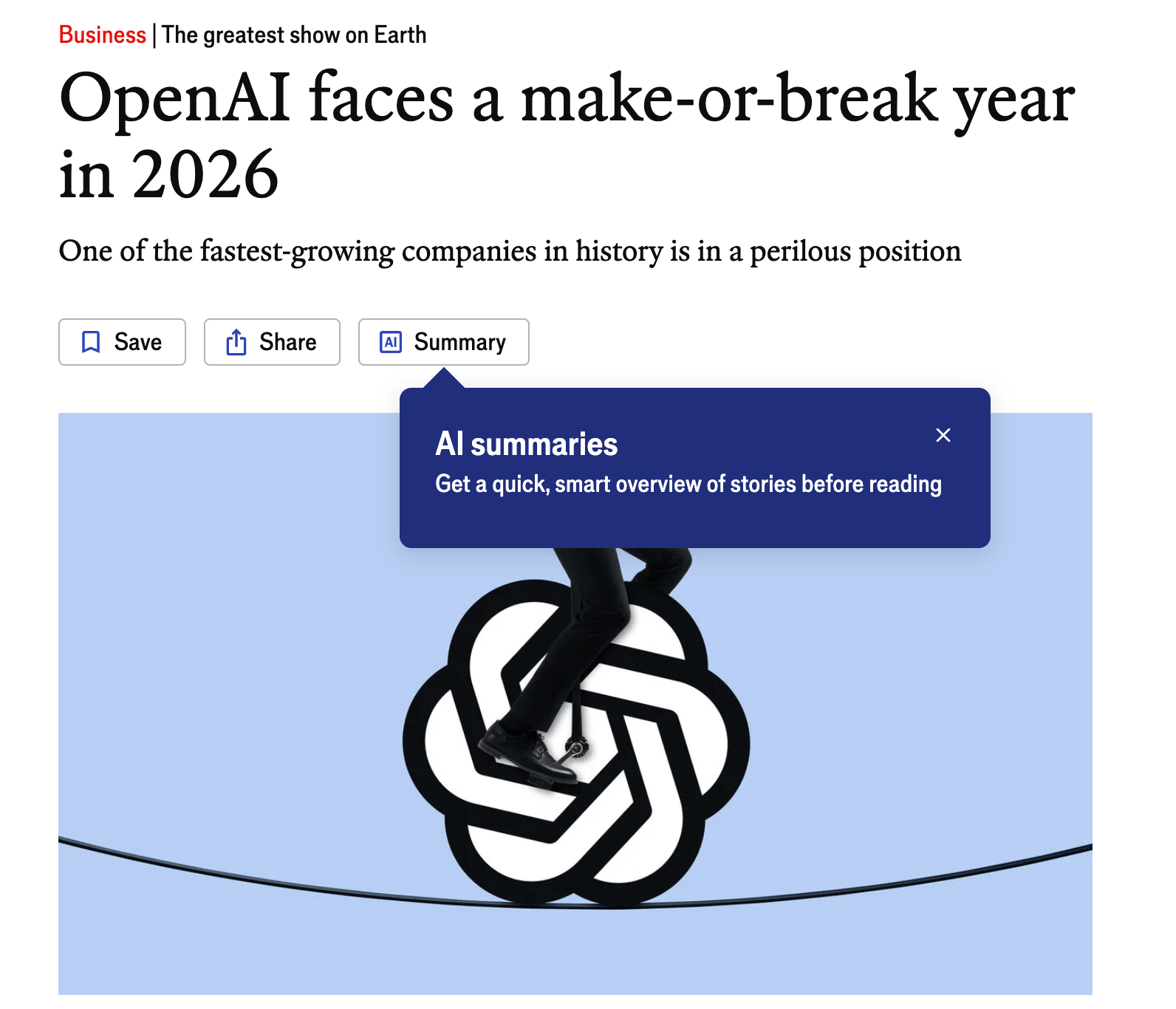
Funnily enough, The Economist offered me an AI summary of this article, which in a way shows that LLMs (whether Altman's or someone else's) have won the race; they are already everywhere, even if OpenAI were to go bankrupt...
Collaboration
What does it mean to work together? Last year, I read a fascinating paper on this subject by VU colleague Jeroen de Ridder: How Many Scientists Does It Take to Have Knowledge? That sounds like the beginning of a joke about screwing in a light bulb, but it's actually a serious question. Traditionally, de Ridder explains, we have viewed knowledge as something that resides in exactly one head. When we read a book by Aristotle or De Beauvoir or Descartes, we can safely assume that what is written there was knowledge that they possessed, that they had thought through and written down themselves. But what are we to make of a paper such as this recent one, which I also co-authored? No fewer than 18 authors contributed to this paper, but what knowledge do we individually have about what it says?
And I have countless papers like this on my resume; papers that I did not write alone but with differnt groups. Papers by two authors where I was the PhD supervisor and therefore occasionally provided guidance from a distance, like a kind of oracle, but also papers by two authors where I worked very intensively with another professor on an equal footing. You cannot tell from such a paper who contributed what knowledge (although some journals are now experimenting with small inserts on which you can indicate your role in the paper). Can you be an author as a group? De Ridder says that there is a case to be made that you cannot:
Groups don’t have minds of their own and, hence, no mental states. Since knowledge either is a mental state itself or at least involves one (to wit, that of belief), it follows immediately that groups cannot literally have knowledge. Case closed.
Luckily, de Ridder is a practical person and is not satisfied with this argument. After all, the reality is that most papers published today are written by multiple authors, so we must also be able to study this process. Especially when you work with people from multiple disciplines, say a sociologist and a computer scientist who draw conclusions together based on a dataset, you need both areas of expertise to understand and defend the conclusion and the process by which it was reached. De Ridder calls this 'warrant':
If an instance of scientific knowledge is the result of practically or cognitively necessary collaboration, it will not only have been produced by a collective, but the warrant for it will often also be shared by the collective and the collective will be in a position to use this knowledge in a number of functional roles. [emphasis mine]
And although people usually use AI alone, it also influences how people collaborate in all kinds of ways. Because collaboration is human work, and that is not simply putting a few separate facts together. This highly readable paper by researchers from Harvard and Carnegie Mellon argues that if people collaborate, but they do not believe that each other has actually put effort into the work, then the collaboration will fail.
Effective collaboration relies on ‘mental proof’, evidence that you have actually done something, or in the words of the authors:
Mental proofs are observable actions taken to certify unobservable facts about the minds who perform them.
I think this is immediately clear to anyone who has ever done a group project at school: collaboration works because you truly believe that others have put effort into the work. Based on someone else's effort, you adjust your own effort and divide up the tasks in a project. Do you think the other person has really done their best? Then you may be willing to contribute more than if you think they could have put in a little more effort.
But according to these scientists, this only works if you really have to put effort into the work:
When AI makes generating high-quality text (and by extension, “ideas”) effortless, it destroys this costly signal.
If we are not careful, we will create teams that work faster but trust each other less (according to the paper) and (I would add) also know less about what their colleagues know and can do, which will make dividing work even more difficult in the future. The abstract of this paper ends with a beautiful question:
How do we signal deep understanding in a world where the output is automated?
Yes, how do we show that we have actually done the work, in a world where there are people who have written 113 papers in a single year? I find it unbelievable that the knowledge in each of those 113 papers, as De Ridder calls it, is warranted by this author; even as part of a group, that seems impossible to me with so many papers. Or, as Peter Naur so beautifully describes, that he has formed a theory for each of the 113 papers. That we can ring him up to:
to explain them, to answer queries about them, to argue about them, and so forth.
AI does not solve that problem; in fact, it makes it worse. Because it lets people publish even more, which changes standards, increasing the pressure to publish even more, etcetera, etcetera.
If people around you are writing 100 papers a year, wouldn't you be crazy not to do the same. The system of knowledge suffers as a result, of course, if we write more and more but understand less and less, as I also said when Aob interviewed me this week.
Whose language model?
A brilliant piece by Marcus Olang about chatGPT, but also about the influence of colonialism on writing, how the English they learned in Kenya (and this also applies to other places where the British were present) was not a living language, but a static one:
The English we were taught was not the fluid, evolving language of modern-day London or California, filled with slang and convenient abbreviations. It was the Queen's English, the language of the colonial administrator, the missionary, the headmaster. It was the language of the Bible, of Shakespeare, of the law. It was a tool of power, and we were taught to wield it with precision.
And it is precisely that kind of language, bare, lifeless, strangely formal, that has now become the language of GPT.
Misogyny on the internet
A year ago, Volkskrant asked me if I wanted to write an article about bias in AI, but I said no. I want to write an article, I said, about how the internet has been rife with organized misogyny for more than 10 years. We are all familiar with bias in AI by now, but how the internet and technology are repeatedly used to keep women down is a story that matters because it remains hidden. It became this piece (in Dutch) almost a year old now, but still as relevant as it was then.
In it, I referred to the Gamergate phenomenon, a movement that insulted, doxxed, and threatened women on the internet, but received little attention in the media. After my piece, I heard from many people that they had never heard of Gamergate. But it was, in the prophetic words of American journalist Kyle Wagner from 2014, only a harbinger of what was to come:
a glimpse of how these skirmishes will unfold in the future—all the rhetorical weaponry and siegecraft of an internet comment section brought to bear on our culture, not just at the fringes but at the center. What we're seeing now is a rehearsal, where the mechanisms of a toxic and inhumane politics are being tested and improved.
And that's exactly how it went. Trump's election was downstream from this movement. Wagner also put his finger on the sore spot about who is to blame for this:
[Gamergate has] exploited the same basic loophole in the system that generations of social reactionaries have: the press's genuine and deep-seated belief that you gotta hear both sides. Even when not presupposing that all truth lies at a fixed point exactly equidistant between two competing positions, the American press works under the assumption that anyone more respectable than, say, an avowed neo-Nazi is operating in something like good faith.
And where did we read this piece, which couldn't have been written better with a crystal ball? The New Yorker? The Atlantic? No... on the unknown sports blog Deadspin. So yes, no one listened (no guarantee that it would have happened on another platform, by the way), and once again we are not taking the threat seriously.
Because even now that it is possible on X to remove clothing from every photo of women, including photos of 14-year-old actress Nell Fisher, the reporting on it, and the response to it, is nowhere near serious enough.
Undressing apps, Dutch newssite nu.nl calls them, instead of what they are, tools with which you can create child pornography, as if it were about a Barbie with a plastic gadget between her spindly legs, and not about sexual images of minors that come by at a rate of thousands per hour. Well, it's all so complex, according to our Minister of Justice Van Oosten in that article.
How complex exactly? Ah yes, apparently too complex for our Secretary of State for Foreign Affairs to not post on Twitter [[11]] anymore...! First you have to scroll through child pornography before you can read what the official position of the State Department on Greenland is. It sounds like an episode of Black Mirror, but it's just a random Wednesday in 2026. Why not at least cross-post such messages on BlueSky, where there is also an account?
God only knows what David van Weel would do without Twitter, apparently. Okay, so if the government stops posting on Twitter, that's not the solution. What is, according to Van Oosten?
Careful consideration, together with all parties involved, is necessary.
All parties involved?! That sounds like a nice chat with Muskie, right? Who, of course, thinks all the fuss is just censorship. Or invite all the scantily clad women over for coffee? What the hell does that say?
And it's not as if countries are doing nothing or can't do anything. You can simply block it, as Malaysia and Indonesia have done, and even the recently very techno-optimistic UK is now considering. Or at least stop posting on it, which really doesn't require anyone's permission, Van Weel.
It again shows how normalized sexual violence against women is here, and how little impression it makes on men, in whatever form it takes.
It is somewhat ironic that the very study that the right (even the somewhat reasonable right) has decided is pointless and a sign of the decline of real knowledge gender studies, while almost everything we see happening now—from threats against women on the internet, not only via Grok, but also, for example, with "smart" sunglasses, to Peter Thiel's long-cherished desire to reverse women's suffrage—can be better understood from the perspective of male-female dynamics and history.
[[11]]: I refuse to ever call it X!
The reader's question: What do you think of this piece?
Sorry English language friends, there are so many Dutch citations in this piece, and it it about a Dutch language article anyway, I don't feel translating makes sense. Long story short it that in the Dutch language region too we have avid AGI believers that complain that others are bias.
Bad news
Last week was CES, the Consumer Electronics Show, once a place where cool new tech was presented, now mainly... AI slop. The prizes for the worst ideas went to, among other things, a lollipop that plays music when you eat it (?) and a refrigerator that opens when you say “open.” Handy when all your appliances have that feature and you open your oven, dishwasher, freezer, and washing machine at the same time.
The oceans are getting warmer. The researcher writing a paper on this calls the situation "bonkers":
“Last year was a bonkers, crazy warming year—that's the technical term,” Abraham joked to me. “The peer-reviewed scientific term is ‘bonkers’.”
He says that he lacks metaphors to explain how much the oceans are warming up. The best he can come up with is that the energy that disappeared into the ocean in 2025 is equivalent to 12 Hiroshima bombs, or the energy it would take to boil 2 billion swimming pools, or more than 200 times all the energy used by everyone in the world. These are all gigantic but also abstract ways of explaining that things are really, really not going well. Even if we stopped using oil and gas now, this warming would continue for hundreds of years, concludes the article in Ars Technica.
Google is putting Gemini in Gmail and all other apps (and can then use your data to train more AI!). Read here how to turn it off! In the EU, it is turned off by default—so don't say we can't do anything against the giants—but if the smart features are turned off, you can no longer use priority inbox! This makes Gmail practically unusable, because all your random newsletters will end up among your important emails. For me, this is 1) a clear form of blackmail, because even without this AI we already had priority inbox, so it's really not necessary, and 2) the last straw, I am now leaving Gmail.
Good news
It's not just parents and older people who are critical of social media; some zoomers understand the problems very well.
Isn't reading better than scrolling? Yes, says this well-researched article in Metro (in Dutch). Reading makes people feel more connected to others. Strange but true, I think social media may be a lot less social than just reading a good story!
Is the internet dead? Maybe, but there are still some amazing places, such as this website that digitizes cassette tapes that you send them.
Events where I will speak in English
- Thursday, February 12, at NWO Insight Out!
Enjoy your sandwich, and maybe also this crazy adventure of a bobsledder who ends up going down alone in a four-man sled.
Member discussion