
Paper: The Computer Science Undone
What ís Computer Science?
While working in computer science for over two decades, so often I have heard people say "that's not (real) computer science". Somehow, as a form of encouragement that I am not crazy, I was in a meeting an hour ago where someone uttered the sentence. If there is something that is not computer science, logic dictates that there must also be something that is, and we could be able to define that. I am interested in this because our field is shaping the world in many ways, so it matters to understand it, but also personally, because I have aften been asked this question (see 2025, week 40 and week 44).
In CS, you don't learn about philosophy of science
However, it remains very hard to define computer science. One reason is that if you study computer science, you rarely learn about epistemology—the science of knowledge—so we all lack the vocabulary to really think about how a field is formed.
The ACM Computer Science Curricula 2023, for example, a document that aims to "inform educators and administrators on the what, why, and how to cover undergraduate Computer Science over the next decade" covers seventeen knowledge areas, but none of these concern research methods, metascience or philosophy of science.
This fits my personal experience of studying computer science at the BSc, MSc and PhD level, you don't really learn about how to do science and about how other fields do it.
And now you might think that that is normal for a STEM field, but it is not. The EU TUNING Qualification defines nine core elements for a physics undergrad program. One is "Experimental design and scientific investigation" and another is "Scientific culture", where they outline that a candidate at the BSc level should be able to
Describe the main traits of the historical and epistemological development of physics and relate them to changes and/or issues in technology, society, and the rules of the scientific community.
So that is... a lot more than I have ever learned, I don't think I heard about the epistemological development of computer science until I was years after my PhD.
And this lack of knowledge about knowledge construction creates issues,
CS is not one, but three things
This lack of understanding of knowledge construction would be an issue, I imagine, in each field, because it means you lack a vocabulary to discuss the issues. But it is even more so in Computer Science, that is not really one coherent field, but three separate ones. There is a mathematical tradition that focuses on proofs, an engineering tradition that builds computers, and aims to also build software with engineering principles and an empirical tradition which supports other fields in analyzing data (adjacent to data science).
These traditions have radically different views on methods and practices of research, and they don't naturally mix. That in itself might not be a problem (physics has theoretical and experimental subfields) but these fields also don't really agree on an overarching goal of the field of computer science.
Are we building software in the real world, which will inevitable change, break and interact with the world, or are we proving how computers behave in theoretical conditions, or are we using computation in a broad sense to advance knowledge in other fields. This missing a unified goal on top of the other disagreements and the lack of knowledge of the issues this might cause, is a problem and this causes "computer science" as a term to be under constant negotiation, exemplified by "that's not (real) computer science". The disciplinary boundaries have to be defined again and again, because everyone is perpetually at risk of being left outside.
One of the subfields that is left out, each time when the lines are redrawn, is anything that has to do with people. Even though Human-Computer-Interaction is a large subfield of computer science (its conference CHI is the largest and most cited of special interest), it does not fit in the three traditions and as such everyone that participates in it, will be confronted with the dreaded "not real" question.
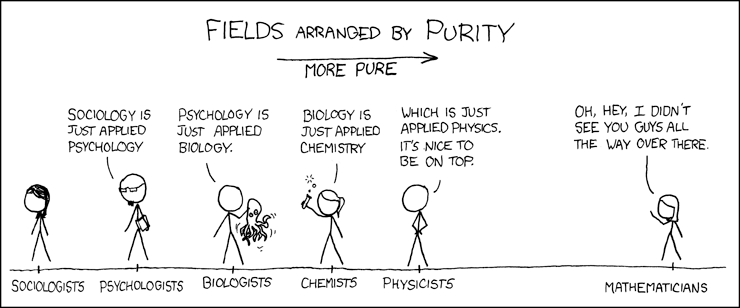
This has, I think, something to do with the hierachie of scientific fields, as so aptly illustrated by XKCD:
What my new paper is about!
Long story still quite long, but I just wrote a paper on all the things above and more! It does these things:
- Analyzes how four different books on the disciplinary boundaries frame computer science (spoiler alert: they all define the three traditions above, more or less). For this I use a framework by Shirley Gregor that asks great questions on scientific fields.
- Notices how human centric fields are left out of the analysis, and contextualizes that with reasons how that came to be (spoiler alert: it not just a matter of comic, like the comic above, citations in fact follow prestige, so in short, sociology cites math more than the other way around)
- Argues that because we lack a good understanding of how science works, research that does study it (Kuhn, Foucault, Hacking) is not cited. This of course is chicken and egg!
Does that sound fun and would you like 30 pages more?! Grab the preprint below while it's hot!
Member discussion