
Special: Een betere universiteit

Deze week een special én een give away (and a translation)! Ik wou zeggen een korte special, maar het is toch een vrij lange geworden, oopsie...
Komende maandag (aka morgen) ben ik te gast bij de launch van het boek Fixing Academia, dat gedeeltelijk door VU-collega's geschreven is. En ik mag er 5 weggeven!!
Om te winnen wil ik graag van je horen wat jouw favoriete paper ooit is. Het mag uit ieder vakgebied zijn, maar wel iets dat voor mij en voor de andere nieuwsbrieflezers enigszins snappen. Stuur me (een linkje naar) het paper en een paar zinnen waarom dit paper jouw leven veranderd heeft. De tips komen natuurlijk volgende week in de nieuwsbrief. Je kan me mailen of simpelweg replyen op deze mail!
Het boek Fixing Academia raakt aan een aantal thema's waarover ik ook vaker heb geschreven en waarover ik al een hele klapper aan links verzameld had—al voor dit boek er kwam had ik hier een special over in gedachten—maar dit was een geweldige kans! Dus hier op thema wat reflecties en leestips!
De gekte van grants aanvragen
Ben je geen wetenschapper, dan ken je dit misschien niet, maar om onderzoek te mogen doen, moet je over het algemeen beurzen (grants) aanvragen, in Nederland bij NWO, of in de EU. Doe je dat niet, dan krijg je zelf maar weinig tijd; 40% is de norm volgens onze overheid maar daar komt bijna niemand aan. Met een beurs kan je jezelf vrijkopen van onderwijs (alleen de term al!) of promovendi of postdocs aannemen. En als je in een vakgebied werkt waar je materialen nodig heb, heb je sowieso extra geld nodig. Dion Kramer schrijft daarover in Fixing Academia:
If I were to apply for an ERC grant, for example, I would have to decide to spend at least half – if not all – of my yearly research time on an application with a 6% success rate.
Bizar, toch? Ik snap eerlijk gezegd niet dat mensen dit nog doen, je krijgt toch meer gedaan als je je onderzoekstijd gewoon inzet voor... onderzoek?
Echter, here's the kicker, en dat staat ook in het boek, een beurs levert je niet alleen geld op, maar ook prestige. Vergelijkbaar met hoe in de startupwereld een grote investering ook credits opleveren. Dat is iemand hoor, want anderen geloven in zijn plannen. Een self fulfilling prophecy want inderdaad, mensen die een prestigieuze beurs krijgen, krijgen er daarna vaker meer, niet (alleen) omdat ze goed zijn, maar ook omdat ze er al eentje hadden. Kramer legt uit:
[G]roundbreaking research on the early-career Veni grant confirms the existence of a so-called Matthew effect in competitive research funding: applicants who won an early career grant by the smallest margin were roughly two-and-a-half times more likely to win a midcareer award than those who fell just short of winning an early career award, without a noticeable difference in scientific output in the intermediate period.
Dus je doet niet alleen mee aan deze zotte race om het geld te winnen, maar ook om de shine ervan. Maar het kost natuurlijk bakken met geld om het zo te doen, want 94% van de mensen krijgt niks, maar die grants moeten we allemaal gelezen worden door andere wetenschappers, en legertjes aan ondersteuners moeten ze checken, doorsturen, en de beoordelingen weer verzamelen en communiceren. Geld in de haard, als je het mij vraagt. Dat becijferden ook Vaesen en Katzav in 2017 al. Iedere onderzoeker in Nederland zo zo'n 4 ton per 5 jaar kunnen besteden als we al het geld van NWO en EU beurzen gewoon zouden ophakken (en dat telt het schrijven en beoordelen van de beurzen NIET mee!)
Over dat beoordelen is nog meer te zeggen dan dat het duur is, trouwens. Ionica Smeets legde laatst in de Volkskrant goed uit hoe zot het is om aanvragen te beoordelen, experts zijn helemaal niet consistent in hun beoordelingen. Hun aanvraag ging van 9.4 het ene jaar naar 6.3 het jaar erop!
Gelukkig zijn er ook initiatieven om dit beter te maken, bijvoorbeeld door loten zoals ik zelf eind vorig jaar ook al betoogde op Radio 1. Ik kreeg toen een fijne mail die vertelde dat de VU-UT alliantie lotingen gaat gebruiken, en dat er in Tilburg al mee geëxperimenteerd is (met als auteur een van de schrijvers van het boek!)
Lezen en schrijven als wetenschapper
In een mooi hoofdstuk van het boek pleit collega Gea Dreschler voor het serieuzer nemen van je taak als schrijver, die je als wetenschapper natuurlijk ook hebt. Als schrijver van papers, maar ook voor een breder publiek. Nou, amen daarop, natuurlijk!
[M] any academics see themselves mostly as researchers; writing articles is just a means to an end. This ambivalence leads to a work culture that does
not support the work of writing in a way that professional writers need.
Schrijven is wat we doen, maar je leert het eigenlijk niet echt in je promotie (of erna, trouwens) en dat moet anders volgens Dreschler:
Craftsmanship embodies skill acquisition, mastering tools and knowledge transfer, and also suggests a system of mentoring and training.
Dit is zooo in lijn met mijn eigen ervaring! Ik had een promotor meedacht bij schrijven van papers, maar systematisch werd er maar weinig gedaan. Een keer een cursus hier, wat feedback op een draft daar, en done.
Iets dat ik vooral nauwelijks geleerd heb, omdat dat in de informatica als niet zo relevant gezien worden, is bijvoorbeeld het echt goed doen van literatuuronderzoek. En dan bedoel ik niet een systematische literatuurreview, waarbij je met exact deze zoektermen in precies die bronnen gaat zoeken, maar de tijd nemen om een vakgebied echt te leren kennen, en methodes om goed bij te houden wat je waar wanneer hebt gelezen en hoe het met elkaar verband houdt.
Voor informatici was het lezen van eerder onderzoek altijd op een bepaalde manier defensief, contrasterend. Snel even kijken of niemand anders dit idee ook al verzonnen heeft, en als dat zo is, even vlotjes uitleggen waarom dat echt heel anders is dan wat wij hier doen. Ook het opzetten van een verhaal- of argumentatielijn heb je in de beta vaak niet expliciet nodig, het is al snel: onderzoeksvraag, methode, resultaten, reflectie, maar zelfs dat soort werk profiteert natuurlijk wel van de leesbaarheid die je oefent in een verhaal. Ik heb eigenlijk wat dat betreft nog het allermeeste opgestoken van presentatiecursussen waarin we oefenden met een verhaal door je onderzoek trekken; in een presentatie op een conferentie is daar vaak veel meer vrijheid voor.
Maar echt een stuk schrijven met wortels in de wereld, a la citation as pilgrimage, op zo'n manier heb ik nooit naar "related work" in een paper leren kijken.
Being in the literature was about inhabiting and belonging, not just about plucking content out and fashioning it into new content.
Ik ben nog steeds aan het hannesen met systemen en software (en deze nieuwsbrief) om het lezen van ander werk echt eer aan te doen. En juist dat is met AI zo nodig, want, blijkt uit onderzoek van oa Columbia University (waarover ook Volkskrant schreef):
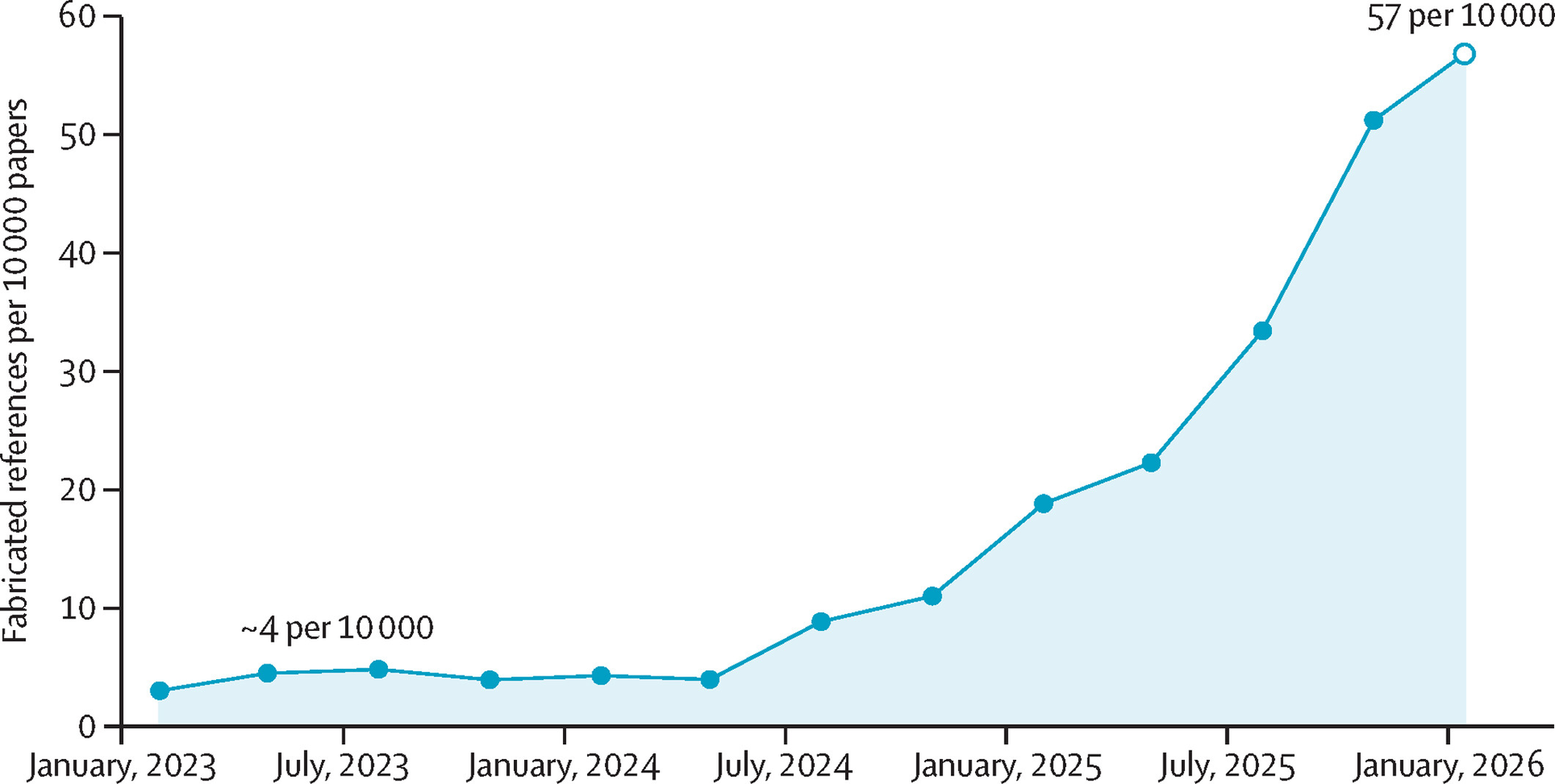
In 2023, approximately one in 2828 papers contained at least one fabricated reference. By 2025, this had risen to one in 458 and in the first 7 weeks of 2026, one in 277 papers had at least one fabricated reference. The fabrication rate increased more than 12 times, from approximately four per 10 000 papers in 2023, to 51·3 per 10 000 papers in the fourth quarter of 2025, reaching 56·9 per 10 000 papers in early 2026 (figure).
Eerder dit jaar werden papers op NeurIPS (de grootste wetenschappelijke AI conferentie) ook al onderzocht, en bleek dat van de 4000 papers er meer dan 50 gehallucineerde referenties bevatten [[1]]. Preprint server arXiv is het trouwens meer dan beu, en die bannen je vanaf nu voor een jaar als je ook AI-slop uploadt, en dat geldt dan meteen voor alle auteurs van een paper, dus als jij (bijv) alleen data analyseert, maar verder niet meeschrijft, ben je ook de sigaar (en terecht!). Ik vind het boeiend trouwens dat arXiv dit doet, maar goed zij zijn ook een partij die ermee moet dealen.
[[1]]: Interessant detail is dat in beide gevallen AI gebruikt werd om te papers te analyseren, alhoewel dat natuurlijk wel (ook) andere AI is dan generatieve LLMs.
Maar, er zijn gelukkig ook mooie initiatieven om (schrijven in) de wetenschap beter te maken! Deze beurs voor wetenschappers om een populair wetenschappelijk boek over hun onderzoek te schrijven!
Work-life balance en academisch ouderschap
Eén van de grote problemen van de wetenschap is de aanname dat mensen enorm willen (en kunnen!) overwerken.
Omdat er steeds minder financiering is, en meer competitie op grants en posities, hebben mensen het idee dat ze er anders niet komen. Nu kan je je afvragen of dat echt zo is, meer uren werken levert volgens mij niet altijd betere resultaten op, maar ja, net als bij grants is het vooral het idee dat je het kan blijven proberen, en wie weet lukt het deze keer.
Het werk is nooit op. In een mooie blogpost legde informaticaprofessor Philip Guo een hele tijd terug al uit waarom academics zich snel overwerkt voelen:
Academics receive work from at least seven independent sources:
[Onderwijs, begeleiding van promovendi, onderzoek doen, grants, taken in de afdeling, taken voor de universiteit, papers reviewen]
None of these sources of work know of or care about one another. They are completely independent. Thus, it's totally up to you to plan your time to balance all of these obligations. Instead of a single boss giving you work to do, academics have seven independent "bosses" pulling them in different directions.
Dit trekt natuurlijk een wissel op iedereen maar in het bijzonder op ouders, en in het bijzonder op moeders.
Recent onderzoek gedaan in the UK, over Deense data schets een tamelijk droevig beeld. Vrouwen en mannen gaan gelijk op in hun vroege carriere, maar nadat ze een kind krijgen, haakt een op de drie vrouwen af. Vrouwen met kind hebben 25% minder kans op een vaste baan, mannen met kind hebben niet minder kans dan mannen zonder kind.
De schrijvers van het paper schatten dat ouderschap zo'n 70% van het gender gap in de wetenschap verklaart, en 40% van het gat in vaste aanstellingen. Dit is een probleem dat je, als je het mij vraagt, niet op kan lossen in het bestaande systeem (kom ik zo nog op terug).
Wat er mist
In grote lijnen vind ik het boek erg tof, en het is fijn dat jonge wetenschappers werken om de boel te verbeteren!! Dat geeft hoop. Ik heb twee "ah, das jammer"-s.
Ten eerste dat het boek niet echt ingaat op de grote problemen in kennisproductie. Het is eigenlijk een boek dat erover gaat om wetenschap beter te maken voor wetenschappers. Nu zal meer financiering en minder werkdruk ongetwijfeld ook leiden tot betere wetenschap, maar het is jammer dat het niet centraler staat, want die problemen zijn groot, zie ook een special van de zomer (en eigenlijk ook in een andere vorige).
Die fraude is het gevolg van precies dat perverse systeem waar veel hoofdstukken in het boek over gaan. Een goed stuk in Vox van politicoloog Alex Lehr stelde dat laatste aan de kaak:
Het echte probleem is de discrepantie tussen prikkels en gewenste uitkomsten. We worden beloond voor het vertellen van heldere, keurig afgehechte verhalen – bij voorkeur verhalen die anderen graag willen horen. Voor het toevoegen van een geloofwaardig ogend laagje 'strenge wetenschap'. Voor theoretische nieuwigheid. Voor genereren van véél publicaties, bij voorkeur 'toppublicaties'. Dat levert ons onderzoeksbeurzen op, carrièrestappen, media-aandacht en invloed op beleid.
En dat is geen zwart-wit, maar een glijdende schaal."Sommige onderzoeken zijn niet bewust frauduleus, maar simpelweg zo slecht uitgevoerd dat het verschil nauwelijks nog betekenis heeft." zegt Lehr daarover.
En zo komen we bij het tweede issue dat ik heb met het boek, dat het aanneemt dat we met een paar kleine ingrepen een systeemprobleem kunnen aanpakken. Het past bij de glaciale veranderingen met bijvoorbeeld "Erkennen en Waarderen change", waarover ik eerder bij Studio VU al kritisch was. Het probleem is niet dat we andere dingen moeten gaan waarderen, het probleem is dat de universiteit überhaupt probeert in kaart te brengen hoe ik het doe. Kenniswerk is niet te meten; dat hele idee moeten we loslaten.
Maar ja, mensen die het halen in het perverse systeem, gaan ook in dat systeem geloven. Uit onderzoek in Nature bleek:
The more experience researchers had, the more likely they were to prioritize journal prestige and methodological rigour. Among those who had authored more than 100 papers since 2020, almost half selected publishing in a high-impact journal [...] as a top-three factor, compared with just under one-third of respondents who had authored one to five papers.
Bizar trouwens toch, mensen met meer dan 100 papers sinds 2020, dat is 20 per jaar. Dat moet je toch samen met promovendi en andere collega's doen, maar maar 28% van die mensen met meer dan 100 papers vindt samenwerken een belangrijke factor, bleek ook uit het onderzoek. De mythe van de geniale eenling blijft levend.
Okee, een hoop klachten, maar wat dan wel, Hermans? I don't know! Dus misschien is er niks beters dan wat deze auteurs heel dapper betogen. Maar zolang het systeem is zoals het is, produceert het mensen die (al is het soms tegen wil en dank) in het systeem geloven.
Er zijn ook onderzoekers die scherper zijn op de situatie, zoals Virginia Dignum op haar blog. Al was dit een stuk in reactie op iemand die voorstelde om in plaats van promovendus een AI te gebruiken dus ja dat lokt ook wat uit.
The disease is an academic system that has quietly decided that the slow work of human intellectual development does not count unless it produces measurable outputs on a predictable schedule.
Ja, dat! Het is een ziekte in een systeem, en dat vergt soms meer dan een pleistertje of een zalfje.
Geniet van je boterham en vergeet niet me jouw favoriete paper te mailen voor een kans op Fixing Academia, en wie weet tot morgen bij de book launch, je kan je nog aanmelden!
English
This week there is a special feature and a giveaway! I meant to write a short special, but it ended up being quite long, whoopsie...
Next Monday (aka tomorrow), I'll be a guest at the launch of the book Fixing Academia, which was co-authored by colleagues from VU University Amsterdam. And I get to give away 5 copies!!
To win, I'd love to hear what your all-time favorite paper is. It can be from any field, but please choose something that I and the other newsletter readers can somewhat understand. Send me (a link to) the paper and a few sentences explaining why this paper changed your life. The winners will, of course, be announced in next week's newsletter. You can email me or simply reply to this email!
The book Fixing Academia touches on a number of themes I've written about frequently and for which I'd already collected a whole bunch of links—even before this book came out—I had a special feature on this in mind, but this was a great opportunity! So here are some reflections and reading tips on the topic!
The madness of applying for grants
If you're not a scientist, you might not be familiar with this, but to be allowed to conduct research, you generally have to apply for grants, in the Netherlands through NWO, or in the EU. If you don't, you'll have very little time for your own research; 40% is the standard according to our government, but almost no one reaches that. With a grant, you can buy yourself out of teaching (the term alone!) or hire PhD students or postdocs. And if you work in a field where you need materials, you'll need extra money in any case. Dion Kramer writes about this in Fixing Academia:
If I were to apply for an ERC grant, for example, I would have to decide to spend at least half,if not all,of my yearly research time on an application with a 6% success rate.
Bizarre, right? To be honest, I don't understand why people still do this; surely you get more done if you just devote your research time to… research?
However, here's the kicker, and this is also in the book, a grant doesn't just give you money, but also prestige. Similar to how, in the startup world, a large investment also brings credit. That's someone, you know, because others believe in his plans. A self-fulfilling prophecy because, indeed, people who receive a prestigious grant are more likely to receive more afterward, not (only) because they're good, but also because they already had one. Kramer explains:
[G]roundbreaking research on the early-career Veni grant confirms the existence of a so-called Matthew effect in competitive research funding: applicants who won an early career grant by the smallest margin were roughly two-and-a-half times more likely to win a midcareer award than those who fell just short of winning an early career award, without a noticeable difference in scientific output in the intermediate period.
So you're not just participating in this crazy race to win the money, but also for the prestige that comes with it. But of course, it costs a fortune to do it this way, because 94% of people get nothing, yet all those grants have to be read by other scientists, and legions of support staff have to review them, forward them, and then collect and communicate the evaluations. Money down the drain, if you ask me. Vaesen and Katzav already calculated in 2017. Every researcher in the Netherlands could spend about 400,000 euros every 5 years if we simply split up all the money from NWO and EU grants (and that doesn't even include the time spent writing and reviewing the grant applications!)
There's more to say about that evaluation process than just that it's expensive, by the way. Ionica Smeets recently explained well in the Volkskrant (in Dutch) how crazy it is to evaluate grant applications: experts are not at all consistent in their evaluations. Their application went from a 9.4 to 6.3 the next year!
Fortunately, there are also initiatives to improve this, for example by using a lottery system, as I myself argued on Radio 1 last year (in Dutch). After that interview, I received a nice email informing me that the VU-UT alliance will be using a lottery system, and that experiments have already been conducted in Tilburg (with one of the book's authors as the lead researcher!)
Reading and writing in acaemia
In a compelling chapter of the book, my colleague Gea Dreschler argues for taking your role as a writer more seriously,a role you naturally have as a scholar. As a writer of academic papers, but also for a broader audience. Well, amen to that, of course!
[M] any academics see themselves mostly as researchers; writing articles is just a means to an end. This ambivalence leads to a work culture that does
not support the work of writing in a way that professional writers need.
Writing is what we do, but you don't really learn it during your PhD (or afterward, for that matter), and that needs to change, according to Dreschler:
Craftsmanship embodies skill acquisition, mastering tools and knowledge transfer, and also suggests a system of mentoring and training.
This is sooo in line with my own experience! I happened to have an advisor who was good at helping with writing papers, but systematically, very little was done. A course here, some feedback on a draft there, and that was it.
Something I've hardly learned at all, because it's not seen as particularly relevant in computer science,is, for example, doing literature reviews really well. And by that I don't mean a systematic literature review, where you search for exactly these keywords in precisely those sources, but taking the time to truly get to know a field, and methods to keep track of what you've read, where, and when, and how it all relates.
For computer scientists, reading previous research was always, in a way, defensive, contrasting. Quickly checking to see if anyone else has already come up with this idea, and if so, smoothly explaining why that is really very different from what we're doing here. In the sciences, you also often don't explicitly need to construct a narrative or line of argument; it boils down to: research question, method, results, reflection, but even that type of writing benefits from the readability you practice in a narrative. Actually I learned the most from presentation courses where we practiced weaving a narrative through our research; there's often much more freedom for that in a conference presentation.
But writing a piece that's truly rooted in the world, a la citation as pilgrimage,I never learned to look at "related work" in a paper that way.
Being in the literature was about inhabiting and belonging, not just about plucking content out and fashioning it into new content.
I'm still struggling with systems and software (and this newsletter) to truly do justice to reading other work. And that is precisely what is so necessary with AI, because, as research from Columbia University and others shows:
In 2023, approximately one in 2828 papers contained at least one fabricated reference. By 2025, this had risen to one in 458 and in the first 7 weeks of 2026, one in 277 papers had at least one fabricated reference. The fabrication rate increased more than 12 times, from approximately four per 10 000 papers in 2023, to 51·3 per 10 000 papers in the fourth quarter of 2025, reaching 56·9 per 10 000 papers in early 2026
Earlier this year, papers at NeurIPS (the largest scientific AI conference) were also investigated, and it turned out that of the 4,000 papers, more than 50 contained fabricated references [[11]] . Preprint server arXiv is, by the way, absolutely fed up with this, and they will now ban you for a year if you upload AI-generated drivel, and that applies immediately to all authors of a paper, so if you (for example) only analyze data but don't co-author, you're also out of luck (and rightly so!). I find it fascinating, by the way, that arXiv is doing this, but yeah, it's them who have to deal with it.
[11]: An interesting detail is that in both cases, AI was used to analyze the papers, although AI systems different then generative LLMs.
But, fortunately, there are also great initiatives to improve (writing in) science! This Dutch grant for scientists to write a popular science book about their research!
Work-life balance and academic parenthood
One of the major problems in science is the assumption that people are willing (and able!) to work enormous amounts of overtime. Because funding is increasingly scarce, and competition for grants and positions is fierce, people feel they won't make it otherwise. Now you might wonder if that's really true; in my opinion, working longer hours doesn't always yield better results, but just like with grants, it's mainly the idea that you can keep trying, and who knows, maybe it'll work out this time.
The work is never done. In a great blog post, computer science professor Philip Guo explained a long time ago why academics quickly feel overworked:
Academics receive work from at least seven independent sources:[Teaching, supervising PhD students, conducting research, grants, departmental tasks, university-wide tasks, reviewing papers]
None of these sources of work know of or care about one another. They are completely independent. Thus, it's totally up to you to plan your time to balance all of these obligations. Instead of a single boss giving you work to do, academics have seven independent "bosses" pulling them in different directions.
This naturally takes a toll on everyone, but especially on parents, and particularly on mothers.
Recent research conducted in the UK, using Danish data, paints a rather bleak picture. Women and men are on equal footing early in their careers, but after having a child, one in three women drops out. Women with children are 25% less likely to have a permanent job, while men with children are no less likely to have one than men without children.
The authors of the paper estimate that parenthood accounts for about 70% of the gender gap in science and 40% of the gap in permanent positions. This is a problem that, if you ask me, cannot be solved within the existing system (I'll come back to that furtheron).
What's missing
Overall, I really like the book, and it's great that young scientists are working to improve things!! That gives me hope. I have two "ah, what a pity" remarks.
Firstly, the book doesn't really address the major problems in knowledge production. It's actually a book about making science better for scientists. Now, more funding and less workload will undoubtedly lead to better science, but it's a shame that this isn't more central to the discussion, because those problems are significant, see also a summer special (and actually another previous one as well).
That fraud is the result of precisely that perverse system that many chapters in the book address. A good piece in Vox by political scientist Alex Lehr highlighted that very issue:
The real issue is the discrepancy between incentives and desired outcomes. We are rewarded for telling clear, neatly wrapped-up stories, preferably stories that others want to hear. For adding a credible-looking layer of "rigorous science." For theoretical novelty. For generating lots of publications, preferably "top-tier publications." That earns us research grants, career advancements, media attention, and influence on policy. (translated from Dutch)
And that's not black and white, but a slippery slope. "Some studies aren't intentionally fraudulent, but simply so poorly conducted that the difference hardly matters anymore," says Lehr on the matter.
And this is the second issue I have with the book: it assumes we can address a systemic problem with a few minor interventions.
But unfortunately, people who succeed in this perverse system also come to believe in that system. Research in Nature showed:
The more experience researchers had, the more likely they were to prioritize journal prestige and methodological rigour. Among those who had authored more than 100 papers since 2020, almost half selected publishing in a high-impact journal [...] as a top-three factor, compared with just under one-third of respondents who had authored one to five papers.
It's bizarre, isn't it? People with more than 100 papers since 2020, that's 20 per year, you've got to be collaborating with PhD students and other colleagues to achieve that, yet only 28% of those with more than 100 papers consider collaboration an important factor, the study also found. The myth of the brilliant individual lives on.
Okay, a lot of complaints, but what to do, Hermans? I don't know! So maybe there's nothing better than what these authors so bravely argue. But as long as the system is the way it is, it produces people who (even if sometimes against their will) believe in the system.
There are also researchers who have a sharper view, such as Virginia Dignum on her blog. Although this was a post in response to someone who suggested using an AI instead of a PhD student, so yeah, that would provoke a reaction.
The disease is an academic system that has quietly decided that the slow work of human intellectual development does not count unless it produces measurable outputs on a predictable schedule.
Yes, that! It is a disease in the system, and that sometimes requires more than a band-aid or an ointment.
Enjoy your sandwich and don't forget to send me your favorite paper to win Fixing Academia, and maybe see you tomorrow at the book launch, you can still sign up!
Member discussion