
Who's afraid of Peter Thiel, 10 years later
This week I was a panelist at an event in Pakhuis de Zwijger in Amsterdam on the worldview of Peter Thiel, which was gratifying, in a weird sense, as I was already writing about him a decade ago!
I started my talk at Zwijger by explaining how my original post from 2016 would have been better told in the shape of the Nazi bar.
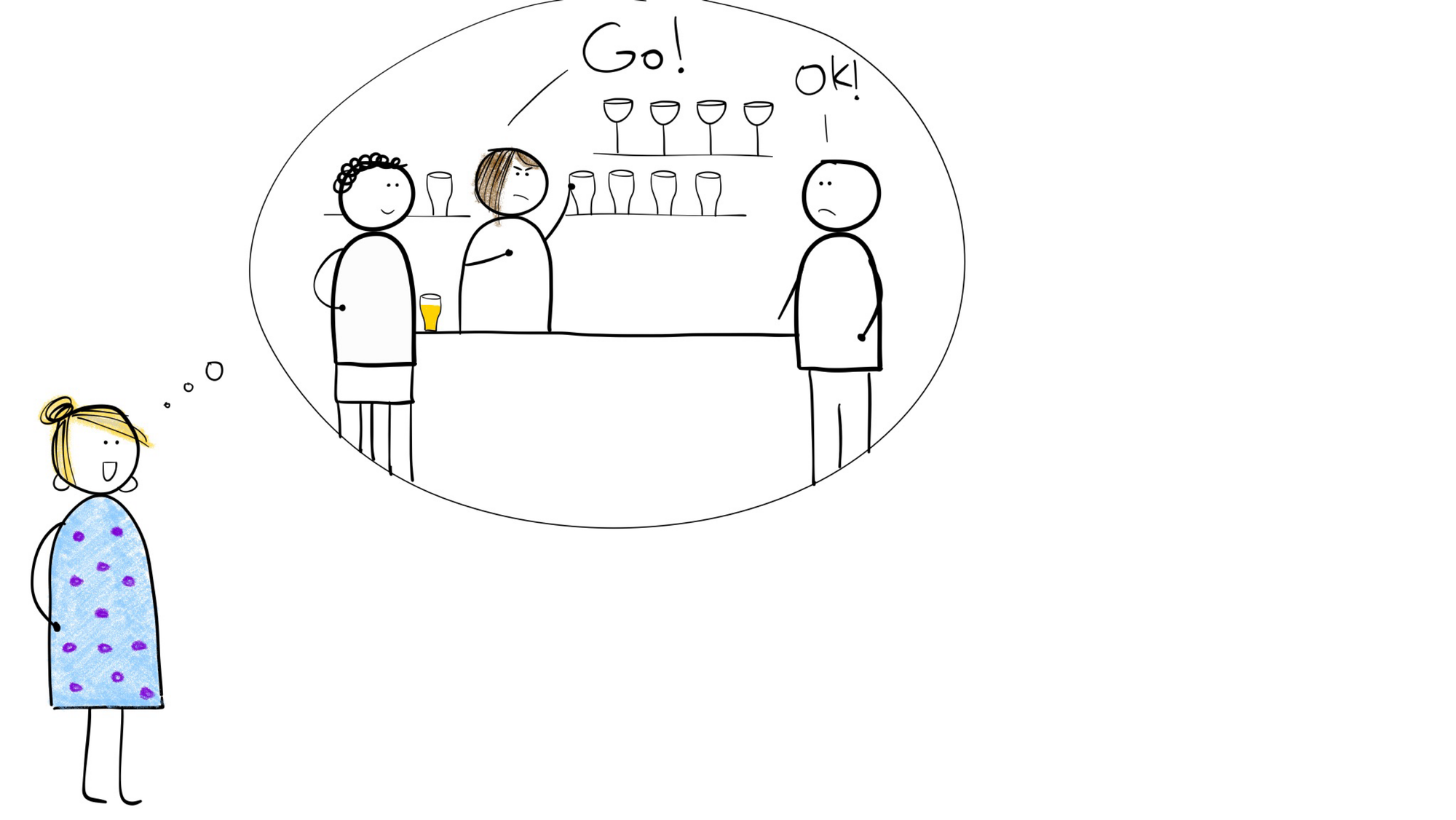
In my post from 2016 I basically argue that there has to be a line somewhere, across which we agree we have left the scope of reasonable discourse. Tech needs to draw this line now, and around Thiel, I said.
The paradox of the paradox of tolerance
The direct reason for my post then, was the somewhat famous Twitter exchange between Paul Graham and ddh [[1]]:
Do you mean YC should cut ties to Peter because of his political views? It seems to me that's the sort of thing we're fighting against.
— Paul Graham (@paulg) October 11, 2016
The response by Graham (and a similar one by Altman, which I suspect was coordinated as it is so similar [[2]]) is interesting as it shows that they really don't understand the paradox of tolerance. The black-and-white-thinking of tech shows up very clearly here. We are fighting intolerance (at the time constructed against, I presume, immigrants) so we must also include people that share that intolerance, or something.
It is of course logically inconsistent, but more so it shows that Graham and Altman are unafraid of being actually, materially, impacted by the intolerance that Thiel was spreading. Which of course is mostly true, because they are rich white dudes.
However, for me it hit really different, I was (and am) afraid, because I am a female and Thiel was directly talking about me.
[[2]]: And there is a lot more to say about Altman then opposing Trump and now sucking up to him, but that today is not the point.
The women's vote was bad
Allow me to explain. As far as I can remember, Graham's Twitter thread was the first time Thiel landed on my radar, and what I saw was not great, especially this piece:
The 1920s were the last decade in American history during which one could be genuinely optimistic about politics. Since 1920, the vast increase in welfare beneficiaries and the extension of the franchise to women — two constituencies that are notoriously tough for libertarians — have rendered the notion of “capitalist democracy” into an oxymoron.
I remember reading this and being genuinely scared. It was the first time I saw women being allowed to vote framed as a bad thing, rather than as progress. And it was clear that the end goal here was to take away women's voting right, I mean it is right there, a bit further along in the post:
In the face of these realities, one would despair if one limited one’s horizon to the world of politics. I do not despair because I no longer believe that politics encompasses all possible futures of our world.
[...]
The critical question then becomes one of means, of how to escape not via politics but beyond it. Because there are no truly free places left in our world [.]
Again, a bit cryptic maybe, but the statement that there are no free places, no places free enough for a person at that time already a multi-millionair is already bonkers, let alone the part where he wants to get rich enough to not need politics.
This movement, at least the part about women, spread immediately, as this was also the time that #repealthe19th was sometimes trending on Twitter, although even pre-Bezos WP was there to tell us to stop worrying:
#Repealthe19th is a real, anti-feminist hashtag that sits at the intersection of the alt-right’s sense of humor and genuine misogyny.
Calm your tits, ladies. It is JuSt A JoKE, har har.
But of course, fast forward a bit and we have a SAVE act that will disproportionally hurt the voting rights of women, an estimated 69 million women might be impacted, plus 140 million Americans without a passport, of course disproportionally poor people lacking the funds for one.
GamerGate
And of course, there were orange signs before the red flashing signs that I saw before Trump 1. The most important one was maybe, GamerGate, which I wrote briefly about for Volkskrant in early 2025, and a Deadspin piece from 2014 is the best background piece on its context if you want to dive in, but it also had a Cassandra-like warning that came true to the letter:
What we have in Gamergate is a glimpse of how these skirmishes will unfold in the future—all the rhetorical weaponry and siegecraft of an internet comment section brought to bear on our culture, not just at the fringes but at the center. What we're seeing now is a rehearsal, where the mechanisms of a toxic and inhumane politics are being tested and improved.
Yes, GamerGate was the testing ground for how the Trump 1 campaign used social media, driven by Cambridge Analytica with Steve Bannon, and Peter Thiel with Palentir.
However, what matters most for me in this context is that GamerGate was the first time, before writing about Thiel in 2016, that I saw women so openly hated in my field. It was such a shock in the 2010s where inclusivity was in, Girls who code was well-funded, and social media was bringing peace and freedom all over the world.
Why were so many of my fellow programmers and gamers so openly hostile about women?!
Tech and the alt-right
And the connection between tech and far right just keeps on being proven, just this week the CEO of a Swedish VPN service donated to a far right party, just as in the Netherlands, the board of the Piratenpartij (pirate party) joined a far right party in 2016.
[[1]]: dhh, who sadly now also has turned into a bigot, but he wasn't then.
Member discussion