
Het AI nieuws van week 4
Het was weer wat deze week met de AI gekte!
The Guardian: Ik schreef al eerder over de gekte in de UK, maar ze hebben weer wat gelanceerd daar deze week! Een AI tool die kabinetsleden kan helpen om te snappen wat mensen van hun beleid gaat vinden. Dan denk ik natuurlijk weer: heb je daar AI voor nodig? Kan je niet beter gewoon je county in gaan en met mensen praten?? Dat heeft als voordeel dat je ook meteen mensen zich gezien laat zien voelen en dat is nou toevallig ook nog eens iets wat je zou willen als politicus (hoop ik...!). Ik ben echt voor data analyse en mensen goed onderbouwd besluiten laten nemen, maar een AI vervreemt mensen juist nog meer van data en van elkaar.
Follow the money: Altijd sterke onderzoeksjournalistiek, dat gaan we de komende jaren echt nodig hebben in de wereld. Zo ook dit stuk over een algoritme Preselect Recidive dat bij de politie gebruikt wordt om te voorspellen of jongeren nog een keer de fout in gaan! Echt een extreem verontrustend stuk want je kan je zo indenken welke mensen dit meer treft. Minority report in de polder.
Financieel Dagblad: Deze week was ik zelf ook nog even in het nieuws in het FD, met een heerlijke headline afkomstig van mij: programmeren is wel meer dan code tikken. Zuckerberg zijn idee om mid level programmeurs te ontslaan slaat nergens op, want goede software maken vergt juist ook nadenken, een consistent plan en afstemmen. En het is vooral een afleidingsmanoeuvre om mensen die kritiek hebben op de anti-DEI maatregelen, de meer "masculine energy" monddood te maken.
Bloomberg: Longread over de invloed van YouTube op de populariteit van Trump. Echt een diepgaande data analyze van 2000 video's, in totaal zo'n 1300 uur. Interessant aan de analyse is dat veel van de top podcasters wel over politiek praten, maar zichzelf explicit apolitiek noemen, ze hebben het over (sport)wedden, de sportschool, meme cultuur, en wigglen de content over Trump, die natuurlijk goed in "lockerroom stoer doen" past, er gewoon tussen. Pas heel dicht op de verkiezing gingen de meeste shows expliciet politieke gasten interviewen. Ook richten ze zich direct op mannen, maar 12% van de gasten in de geanalyseerde shows zijn vrouwen, en dat zijn ook de mensen die op Trump stemden (50% van de mannen onder de 30, aldus dit stuk). Maar wat me het meest val bijblijven van dit stuk is niet de data, maar een quote van Mike Majlak "The easiest route these days to viewership is by creating enemies". Dit zijn mannen die het algoritme snappen, en weten dat niet meer kwaliteit, maar boosheid een show cachet geven.
Club de Madrid: Achttien oud-Europese leiders roepen van der Leyen op om Google op de hakken, en de AdTech kant los te trekken. Ik kende de term AdTech eigenlijk niet echt tot deze hele goede aflevering van Mystery Hype Theater 3000 van afgelopen zomer (hele podcast is sowieso een aanrader!) Wat me aan die aflevering weer is bijgebleven is dat Google heel stiekempjes hun doel veranderd heeft. Ze zijn gegaan van: "he, hier is een website waar misschien op staat wat je zoekt", naar "hier is het antwoord op de je vraag", wat hele andere soorten vragen zijn!
Nature: Onderzoek onder bijna 1500 mensen gepubliceerd in Nature laat zien dat als je met AI werkt, je beoordelingsvermogen verandert, en dat dat al bestaande bias in mensen vergroot. Het effect van een AI op mensen is groter dan het effect van andere mensen op mensen. De onderzoekers schrijven over "... a mechanism wherein AI systems amplify biases, which are further internalized by humans, triggering a snowball effect where small errors in judgement escalate into much larger ones."
Dit is een vorm van morele deskilling waarover Evgeny Morozov schrijft in zijn book To Save Everything, Click Here. Als je zelf niet meer hoeft te denken over wat correct is (bijv als je door poortjes bij de metro niet meer kan zwartrijden) dan ga je dat na verloop van tijd ook niet meer doen. Goed dat er uitgebreid onderzoek is dat dat nu onderschrijft, ergens jammer dat het onderzoek nodig is terwijl het zo voorspelbaar is.
NBC News: Een AI systeem gemaakt op wapens op scholen te detecteren (dystopisch op zich) werkte niet goed in een recente school shooting omdat de dader niet goed voor de camera's stond. Een goed voorbeeld van een technische oplossing voor een probleem dat je ook met wetgeving of met normen kan oplossen (zoals in Nederland).
Kleine dingen: Ik sluit m af met een soort hoopvol bericht, we horen steeds luidere oproepen voor meer gedecentraliseerde social media, bijv op 404 media. Het is ergens jammer dat BlueSky een fijner Twitter alternatief is van Mastodon want dat is natuurlijk wel democratischer, maar het is allicht iets. Ow en let op! Microsoft kan binnenkort al jouw teksten in Word gebruiken om Ai te trainen. Wil je dat niet? Hier lees je hoe je het uitzet.
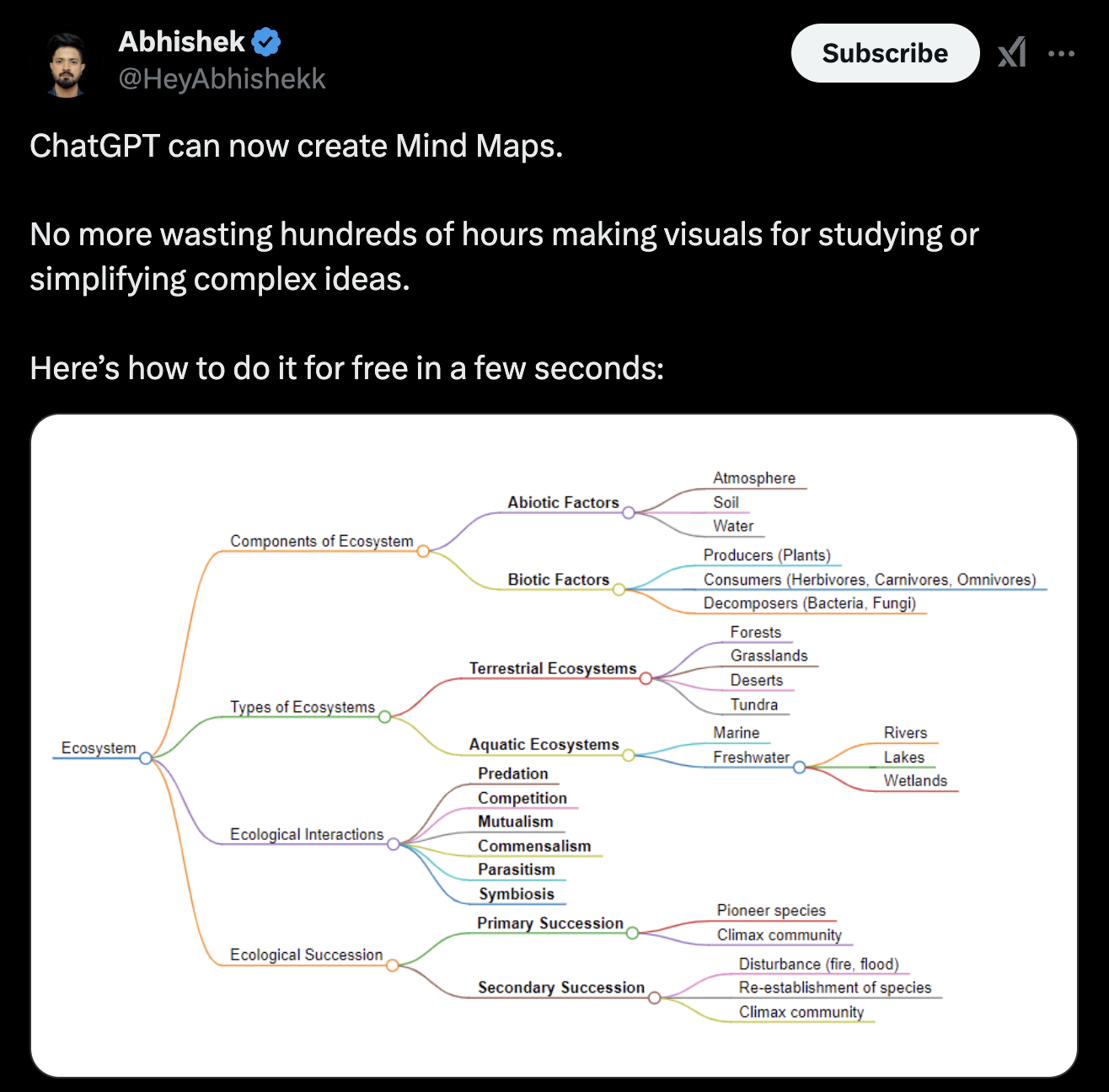
Ok, nog eentje dan, voor de comic relief... Je kan nu met chatGPT ook mindmaps maken. Veel enthousiasme op de socials natuurlijk want dat bespaart uren studeren en versimpelen!!! Maar, denk ik dan, dan heb je echt het nut van een mindmap niet begrepen, het nut is juist om complexe informatie zelf te verwerken.
English
It was another wild week of AI craziness!
The Guardian:
I’ve written before about all the madness in the UK, and this week they’ve launched something new over there —a tool powered by AI that helps Cabinet Ministers understand how people might react to their policies. And naturally, I can’t help but ask: do you really need AI for that? Wouldn’t it be better to just go out into your constituency and talk to people? That way, you immediately make people feel seen—and that’s exactly what you’d want as a politician (I hope so…).
Follow the Money:
Always delivering top-notch investigative journalism, -which is exactly what we’re going to need more of in the coming years. For instance, there’s this piece about an algorithm called Preselect Recidive that the police use to predict whether young people will slip up again! It’s an extremely disturbing article—one can easily imagine which groups would be affected the most. It’s like a Dutch version of Minority Report.
The Financieel Dagblad:
This week I even made a brief appearance in the Dutch economic and financial daily news outlet FD (Het Financieele Dagblad), with a delightful headline of mine: Programming Is More Than Just Typing Code (in Dutch). Zuckerberg’s idea to fire mid-level programmers makes no sense—good software requires thought, a consistent plan, and coordination. Moreover, it seems like nothing more than a diversionary tactic to silence those who criticize the anti-DEI measures, effectively muting their so-called “masculine energy.”
Bloomberg:
A long read on the influence of YouTube on Trump’s popularity offered a truly in-depth data analysis of 2,000 videos—totaling roughly 1,300 hours. What’s interesting about the analysis is that many top podcasters do talk about politics, yet they explicitly claim to be apolitical. They cover topics like sports betting, the gym, and meme culture, casually weaving in content about Trump that fits perfectly with the “locker room tough guy” vibe. It wasn’t until just before the election that most shows started interviewing explicitly political guests. They also target a male audience—only 12% of the guests in the analyzed shows are women, and according to the piece, these are also the people who voted for Trump (50% of men under 30, it claims). But what struck me most from the article wasn’t the data, but a quote from Mike Majlak: “The easiest route these days to viewership is by creating enemies” . These are men who understand the algorithm and know that it isn’t quality, but anger, that gives a show its cachet.
Club de Madrid:
Eighteen former European leaders are calling on von der Leyen to take on Google and dismantle the AdTech sector. I didn’t really know the term “AdTech” until that excellent episode of Mystery Hype Theater 3000 last summer (the entire podcast is a must-listen!). What really stuck with me from that episode is that Google has very subtly shifted its goal—from “Hey, here’s a website where you might find what you’re looking for” to “Here’s the answer to your question,” which implies an entirely different kind of inquiry.
Nature:
Research involving almost 1,500 people published in Nature shows that working with AI changes your judgment and actually amplifies the biases already present in people. In fact, the effect of AI on people is greater than the effect of other people. The researchers write about “… a mechanism wherein AI systems amplify biases, which are further internalized by humans, triggering a snowball effect where small errors in judgment escalate into much larger ones”. This is a form of moral deskilling that Evgeny Morozov writes about in his book To Save Everything, Click Here. If you no longer have to think about what is correct (for instance, if you can no longer sneak past the metro turnstiles), eventually you’ll stop doing it altogether. It’s good that there’s comprehensive research confirming this—even if it’s a shame that such studies are needed when the outcome is so predictable.
NBC News:
An AI system designed to detect weapons on school premises (a dystopian idea in itself) didn’t work well in a recent school shooting because the shooter wasn’t properly in view of the cameras. This is a prime example of a technical fix for a problem that could just as easily be solved through legislation or standards (as is the case in the Netherlands).
A Few Minor Notes:
I’ll finish with a somewhat hopeful message: we’re hearing louder calls for more decentralized social media, for instance on 404 Media. It’s a bit unfortunate that BlueSky turns out to be a nicer alternative to Twitter than Mastodon—since Mastodon is arguably more democratic—but it’s something. Oh, and a heads-up! Microsoft might soon use all your texts in Word to train its AI. Don’t want that? Here’s how you can disable it.
One more thing, for comic relief… You can now create mind maps with ChatGPT. There’s plenty of excitement on social media about how it saves hours of studying and simplifies everything!!! But if that’s the case, then you really haven’t grasped the purpose of a mind map—the true value lies in processing complex information yourself.

This newsletter was translated by Johanna Guacide.
Member discussion